

The Recording Equipment of Double Fantasy
Updated: Jun 17
Preamble
Knowing the story and timeline of the sessions will help you understand the information presented here much better. I highly recommend reading the excellent oral history Starting Over: The Making Of John Lennon and Yoko Ono's Double Fantasy by Ken Sharp.
In short though, it's important to know that the sessions for Double Fantasy and Milk and Honey were essentially one and the same, at least as far as recording John's songs go. I mostly write "Double Fantasy" in these pages, but the information all applies for the recording of Milk and Honey as well. Additionally, all of the recording and most of the mixing took place at the Hit Factory. An handful of songs were mixed at the Record Plant, so the information that applies to the Record Plant is specifically noted.
Double Fantasy Input List
Below is a scan of Assistant Engineer Jon Smith's actual 1980 input list from one of the live tracking sessions for Double Fantasy. We can see how they laid out the 32 channels of the Neve 8068 before going to tape and some of the microphones chosen by engineer Lee DeCarlo.
Smith admits that "For some reason I never filled in the drum mics. It’s an unusual oversight and I can’t explain it." Fortunately though, through photos I have been able to identify at least some of the drum microphones. Many thanks to Smith for allowing me to share this document!

Recording Equipment
AKG C414
Jon Smith's input list shows that the grand piano was mic'ed with two AKG C414s. The C414 is a classic studio microphone that has had something like eleven versions (depending on how you count some of the variants) since it was first introduced in 1971. In 1980 there had been three versions released - C414 Comb, C414EB, and C414EB-P48 - so we can narrow the C414s used on Double Fantasy to one of those.
The 414 Comb, released in 1971, was a direct descendent of the C412, which itself was AKG's FET version of the venerated C12A. The C414 Comb kept the electrical design and revered CK12 brass capsule of the C412 but added a hyper-cardioid pattern to the cardioid, omni, and the figure 8 available on the C412. The C414EB was released in 1976 and added a 2-position pad switch, a 3 position bass roll-off switch, as well as some functional upgrades. Oddly, at some point in it's production AKG dropped the brass CK12 capsule in favor of a easier to manufacture nylon capsule but didn't change the model number.
In 1980 AKG changed how the C414 handled power from variable to fixed 48-volt phantom power dubbing this new version C414EB-P48. The EB-P48 was similar to the nylon-capsuled EB's, minus the aforementioned power change, a higher sensitivity of 9mV/Pa (vs 6-mV/Pa), and a somewhat higher impedance.
As for exactly which version of the AKG C414 the Hit Factory had in 1980, that remains a mystery.

AKG C452
Assistant Engineer Jon Smith says that when recording Hugh McCracken's acoustic guitar they may have used an AKG C452. "Hugh McCracken also had a mic for acoustic guitar out in the studio. I’m not sure what we used but it might have been a Neumann 87, KM84 or maybe an AKG 452. (Smith, Jon. "Re: Lennon Information." Received by Solo Beatles Studios, 16 Oct. 2024.)
The AKG C452 was small diaphragm condenser. It was part of a line of mics made by AKG dating back to the late 1960's that used their modular "CK" capsule design called the Condenser Modular System (CMS). The most famous capsule, and most likely to have been used on McCracken's guitar, was the CK61 cardioid capsule. The C452 and its cousins are usually described as bright and clear, but not harsh. They are a favorite on high hat and acoustic guitar.
AKG K 240
Every photo I've seen of the sessions the headphones being used during tracking and overdubs were AKG K 240s. K240s are over-ear, semi-open studio headphones that were first released by AKG in 1975. The K 240 became a pretty common studio headphone by offering decent sound quality and comfort and being pretty affordable.
=AKG is still manufacturing K 240s fifty years later with some slightly different specs. The newer version have an impedance of 55Ω, but the version that was around in 1980 had an impedance of 500Ω, meaning they would have needed a pretty robust amp to drive them. Unfortunately, I haven't been able to find out any information on how The Hit Factory was handling their cue system at the time.

Ampex MM 1200 [Record Plant Mix Room]
The Double Fantasy mixing sessions moved from the Hit Factory to the 10th floor mix room at The Record Plant from 25 September to 1 October 1980. Four songs were mixed during this period: "(Just Like) Starting Over", "Kiss Kiss Kiss", "Watching the Wheels", and "Give Me Something".
Pictures show the multitrack tape decks in the 10th floor mix room were two 24-track Ampex MM 1200's. Double Fantasy was recorded at the Hit Factory on two synchronized 2-inch 16 track machines, so to play the tapes back the MM 1200's at the Plant would have had to have had 16-track headstacks and a sync system as well.
At a distance the MM-1200 looks nearly identical to the slightly older MM-1100, but an April 1980 studio listing in Mix magazine (Vol. 4, No. 4) for the Record Plant confirms the machines were 1200's. The Record Plant posted a classified ad in the October/November 1976 (vol. 2, no. 1) issue of Modern Recording for two of their 16-track MM-1000's, so my guess is that they probably bough their MM 1200's right when they came out in 1976 to replace the 16-track MM-1000s.
First released in 1976, the 1200 was an upgraded version of the already well-respected 1100. 1200's had all the features and modularity you'd expect from a professional multitrack machine, and a sound that was loved by many engineers.

Ampex Tape (unknown formulation)
Photos from the control room show 2" and 1/4" Ampex tape boxes. I'm not sure exactly what formulation they used, but my guess is that it was 456. 456 was one of the most popular and best selling audio tapes of all time. Many engineers consider it to have a distinct "sound" compared to other, cleaner formulations, which could be an asset or liability depending on the situation.
Ampex was so pleased that their tape was used on Double Fantasy that they gave Hit Factory owner Eddie Germano a "Golden Reel Award" to commemorate the album. The award is kind of funny though seeing as how Geramano would like have had absolutely nothing to do with what tape was chosen for the sessions. It was almost surely selected by Lee DeCarlo, perhaps with input from Jack Douglas.
Left: Ampex tape boxes - Photo: Roger Farrington. Right: Ampex Golden Reel Award - Photo via TracksAuctions.com
API 550 (8x)
In one of the back racks in the control room we can see eight API 550 EQs in a 10 space 500-series enclosure. I was surprised to see a 500-series rack in 1980, but some research led me to find out that Datatronix was making a 10-space 500-series chassis as early as 1978.
The console in Studio A6 was a Neve, so having some API EQs for engineers that liked the "API sound" makes total sense. Neve is frequently described using words like "smooth", "big", and "rich", while API is contrastingly "aggressive", "punchy", and "muscular". And to that end, 550 EQs are a huge component of the API sound.
At this distance its impossible to tell if these EQs are 550's or 550A's. The original 550 EQ was released in 1969 and was one of if not the first ever 500 series module. It is a three-band Proportional Q design with 11 frequency selections and switchable high and low pass filters. API followed the 550 quickly with 550A in 1971. The 550A is a very similar design but added four more frequency selections to the 550 for a total of 15.

API 550 (4x) [Record Plant Mix Room]
Like Studio A6 at the Hit Factory, the mix room at the Record Plant also had a 10-space 500-series rack, and like the Hit Factory the Record Plant's rack was loaded with API EQ's. As above, impossible to tell if the Plant's 500's were 550's or 550A's. See above for more information on 550's in general.

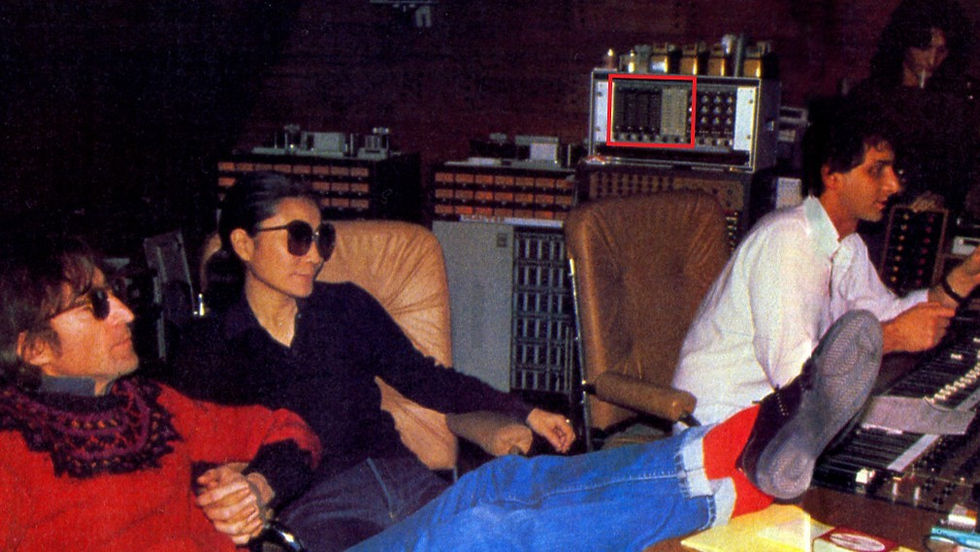
API 560 (6) [Record Plant Mix Room]
The Record Plant 500-series rack also looks to contain 6 API 560's in addition to the 550s. To me it looks like 4 black 560s and 2 white 560s. I'm fairly sure that API had made custom white consoles in the '60s and '70s which could explain the white modules, though its entirely possible that they are something else completely.
The 560 was first released by API in 1969 for use in it's consoles. It is a 10-band proportional-Q EQ with 12dB of boost/cut for each band. The bands are set at octave intervals at 31Hz, 63Hz, 125Hz, 250Hz, 500Hz, 1kHz, 2kHz, 4kHz, 8kHz, and 16kHz.
API 3232 [Record Plant Studio B]
The mixing sessions at the Record Plant moved from the 10th Floor Mix Room to Studio B on 29 September 1980. Assistant Engineer James Bell says that the move to Studio B was made because engineer Lee DeCarlo wanted to mix on a console with automation. According to a 1980 Mix magazine studio listing (Vol. 4, No. 4), the Plant had a 40-input, 32-output API 3232. Stock 3232's have, wait for it, 32 channels so the extra eight channels as well as the double patchbay on the left side would both have been customizations.
An important part of the story of Double Fantasy turned out to be the automation on this console. After all the drama that came with John & Yoko choosing the Hit Factory for recording and then moving mixing over to the Record Plant for mixing, it was the poorly performing automation on this console that eventually led to them returning to the Hit Factory to finish mixing.
Assistant Engineer Jon Smith told me "It was a nice room but it turns out that the wonderful console and modern automation [that they were told the Record Plant had] wasn’t even at the New York Record Plant. That was in their studios in Los Angeles. The New York room had an fairly old small mixing console that had terrible, outmoded automation.
With every pass of automation, there was a slight delay added to all our moves. This meant that if you rode an instrument’s volume in the first pass and then did four more passes while riding other instruments, that first ride would now be late. So we had to limit ourselves to only three or so passes of automation. After that, everybody in the room was assigned faders to make moves on during the bounce down. John and Yoko were not too pleased about this as they’d been told how wonderful the console would be.
We made it work but I believe there were ongoing conversations between John, Yoko, and Eddie Germano. One night after we finished mixing, I was told to pack everything up to move the project back to The Hit Factory. And so, we moved back." (Smith, Jon. "Re: Lennon Information." Received by Solo Beatles Studios, 3 Dec. 2024.)
As for what kind of automation would have been installed on the Plant's 3232, I'm not exactly sure. It looks like API had a system early on called Model 1024 "Model Random Access Programmer", and a slightly later system called "Total Recall". Based on API's website I think its possible that the Random Access Programmer system evolved into Total Recall at some point in the mid '70s. Regardless, I believe both systems were VCA systems, unlike the motorized NECAM system on the Hit Factory's Neve.

The 3232 was eventually acquired by producer Daniel Lanois in 1989 or 1990 and installed at his New Orleans studio Kingsway. During Lanois' ownership of the 3232, the 550's parametric EQs were replaced with 40 API 560 graphic equalizers. Kingsway hosted Bob Dylan, U2, R.E.M, Pearl Jam, Peter Gabriel, Emmylou Harris and a host of other incredible artists before closing for good in 2000. Unfortunately I haven't been able to find any information about the console's whereabouts since 2000.

API Sidecar (unknown model) [Record Plant Mix Room]
According to Record Plant Assistant Engineer James Ball in the book Starting Over, a sixteen channel API that "floated around mostly on the trucks" was brought into the 10th Floor Mix Room for the Double Fantasy mix sessions (Sharp, 2010, p. 132). By "the trucks" Ball meant the Record Plant's two legendary mobile recording trucks, usually referred to as the "white truck" and the "black truck" that recorded thousands of concerts including George Harrison's Concert For Bangladesh.
I can't find any direct documentation of what sidecar the Plant owned, but the classic 16 channel API sidecar in the '70s was the 1604. The 1604 had 16 input channels, 4 groups, front and rear mixing buses, 4 "echo" sends, and 2 "foldback" sends. They came stock with 16 550A EQs, but were frequently customized with at least a few 560's and frequently a pair of 525 compressors.
Audio Kinetics Q-Lock Synchronizer
The system used to synchronize the two Studer A80 tape machines at The Hit Factory was an Audio Kinetics Q-Lock Synchronizer. The Q-Lock Synchronizer was a system that allowed up to four different tape machines to be synchronized for recording and playback. In the case of Double Fantasy, they recorded on two Studer A80 tape machines with 16-track heads. This allowed them extremely high fidelity and low noise, with the flexibility of being able to use 32 tracks (in actuality it was more like 28 tracks, see the Studer A80 section for a detailed explanation).
Audio Kinetics released the Q-Lock Synchronizer in 1978 and although it got the job done, the nascent technology was far from perfect. Assistant Engineer Jon Smith explains, "The technology to do this [synchronizing machines] was brand new and very, very funky. You had to wind the two machines back to about thirty seconds before the song, let them both park, and then hit play on the Q-Lock controller remote which sat with the Studer remotes. The two machines would start rolling and over the next 30 seconds they would try to lock into synch with each other.
We could hear the second machine’s music speeding up and slowing down as it tried to lock in. Sometimes it worked, sometimes it didn’t. If it didn’t, we’d have to rewind and try it again. If they locked, we’d all give a little sigh of relief and do the overdub. I got pretty good at getting them to lock. It was actually quite amusing listening to the chaotic mess of audio that came through the speakers while this was happening." (Smith, Jon. "Re: Lennon Information." Received by Solo Beatles Studios, 24 Oct. 2024.)

Audio Techniques Big Reds
Photos show that there were Audio Techniques Big Red speakers in the live room for playback speakers. The small control room at the Hit Factory was crammed with gear, two or three engineers and a producer, so I think there's a good chance the band would have listened to playback in the live room on headphones or the Big Reds most of the time.
Big Reds were manufactured by Audiomarketing Ltd. for Audio Techniques who licensed the design The Mastering Lab, a kind of confusing circumstance, I know. Big Red's use Altec 604G speakers and a custom crossover designed by The Mastering Lab, a popular mastering studio in Los Angeles. Big Red's became very popular in the '70s and could be found in many of the biggest studios in the world.

Auratone 5C Super Sound Cube
Sitting on the meter bridge we can see an Auratone 5C Super Sound Cube speaker. Auratones were (and still are) a ubiquitous studio monitor designed to be a "real world" reference. In the days where radio was king, Auratones allowed engineers an approximation of how something might sound on the radio or other consumer devices. They can also be helpful as reference for balance, midrange, and mono compatibility which is why they are still utilized by recording and mix engineers the world over.

BTX SIMPTE Tape Controller [Record Plant Mix Room]
To play the tapes recorded at the Hit Factory on two synchronized tape machines, the Record Plant also needed a device to sync their tape machines. According to Record Plant assistant engineer Steve Marcantonio, they used a "BTX" which he describes as a "white little console". I think the model was likely a BTX 4600 which was released in 1980 and was a, well, a white little console.
As I've described in the Audio Kinetics Q-Lock section, synchronizing two tape machines with SMPTE time code in 1980 was still a somewhat inexact process. In fact, Marcantoonio was chosen to work on the December 1980 sessions with John and Yoko precisely because he knew how to operate the BTX synchronizer. "Along the way I got to learn about a very valuable piece of equipment back then it was called the BTX. It was this white little console that held two tape machines together. Well in September [he was already booked but ended up working on the December sessions. -Ed] of that year Jonny and Yoko were working on Double Fantasy and they booked the studio and they wanted me because I knew how to use the BTX." -Steve Marcantonio (source).

Datamix Custom Console [Record Plant Mix Room]
As previously mentioned, four songs on Double Fantasy were mixed at the Record Plant from 25 September to 1 October 1980. I was having trouble figuring out what the console was in the 10th floor mix floor mix room, but I think I now know why. I now believe it was a custom console built using modules from one or possibly both of the Datamix consoles from Studios B & C that were decommissioned around 1975.

Finding specific details of thie mix room console or even the Datamix consoles from Studios B & C has proved difficult so far. I have, however, found a photo of a photo of John and Jimmy Iovine with the Datamix console in the Record Plant Studio C in 1974. Those modules are clearly some version of a Datamix channel strip. Studio C was also on the 10th floor and I think its probable that those very modules ended up in the mix room console that Double Fantasy was mixed on six years later.

From what I can tell by searching online, late-60's Datamix channel strips are all fairly similar but have slight variations, probably based on customer requests. The versions all share some kind of preamp gain, mic/line switch, 3-band eq, "echo" or "cue" send, and EQ in/out switch. Some feature stepped input gain, others have variable input gain, some include pads, some offer "A"/"B" toggle switches, and others have "BEF"/"AFT" toggles.
Most sources say that the EQ's are inductor based. They have 6 toggle switches, two for each band. LF: 30/60Hz, & 120/240Hz, MF: 500/800Hz, & 1.2/2kHz, HF: 3/5kHz, & 5/10kHz. I'll be honest and say that I'm not quite sure how the EQ controls functioned though. Though there are two frequency selection switches per-band, there are only three sliders, one for each band. If anyone knows, please shoot me a line.
The below photo is the only other one of the mix room Datamix I've been able to find, and it gives us a little more detail than the Double Fantasy photos. Counting the faders it seems to be a 32 channel console, and have fairly modest send and bussing capabilities. I believe this console did not have any automation capabilities which is why the moved to Studio B after mixing "(Just Like Starting Over" and "Kiss Kiss Kiss" on the Datamix.

At some point in the early 1980s, not long after the Double Fantasy mix sessions, the Datamix in the Record Plant mix room was replaced by a Trident TSM. The current whereabouts of the custom Datamix are unknown. My guess is that it was parted out because it was seen as having limited utility by 1980s standards.
Dolby 361 Dolby Noise Reduction Unit (2x)
There are two Dolby 361 noise reduction units in this rack in the control room. Dolby noise reduction was a system that was used to reduce high frequency noise (hiss) on tape. The audio signal would be encoded during recording and decoded during playback using the same unit. As with all things, there's no such thing as a free lunch so the process left some artifacts. Some engineers could live with these artifacts and some preferred to live with the natural tape hiss.
Double Fantasy was recorded with no Dolby noise reduction so these 361's would not have been in use for that purpose. There is another possibility though. A technique that became very popular in the seventies - now usually referred to as the "Dolby A Trick" - involved using Dolby A as an enhancer. Encoding Dolby uses a series of filters and upward expansion, so recording a signal through the encode side but playing it back without decoding added subtle high frequency sheen and luster to a signal dynamically.
Engineers found that this effect could be further refined by modifying their units. The encoding process works by splitting the signal into four different frequency bands, and by disabling the encoding on the bottom two (under 3kHz) bands the effect was enhanced even further.
In fact, this modification is sometimes called the "John Lennon Mod". I've been trying to find the origin of this name, but I've yet to find any solid information. My guess is is that rather than having any thing directly to do with John, it was more of a colloquialism amongst engineers that referenced John's known love of "enhancing" his vocals with ADT, double tracking, slap delay, and various other processes. If you have any more concrete information about where this nickname came from, I'd love to hear from you.

Dolby M16 Noise Reduction rack (2x)
Below the two Dolby 361s units were two Dolby M16 racks. The top rack is fitted with sixteen Cat. 44 I/O interface modules, and the bottom with eight. These I/O modules would have corresponded with noise reduction cards within the chassis, most likely Cat. 22 Type-A cards.
While the 361 units were single channel, The M16 units with corresponding cards were used to encode and decode Dolby for mutitrack tapes. One interface module and card equals one channel of processing so this particular rack could encoded and decode 24 channels of tape. However as I stated above, Double Fantasy was recorded with no Dolby noise reduction so these M16 units would have been inactive during the sessions.

Electro-Voice RE20
Jon Smith's input list shows that the bottom of the Leslie organ speaker was mic'ed with an Electro Voice RE20 microphone while the top was mic'ed in stereo with two Neumann U87s. These three inputs were almost surely bussed down to two channels before being sent to the multitrack tape machine during tracking.
The RE20 is a large diaphragm dynamic microphone that features Electro-Voice's Variable-D technology which reduces the proximity effect. Variable-D can be very useful in a situation like the bottom of a Leslie where you want to capture full low-end while minimizing the thumps that can come from the wind created by the rotating bottom rotor.

EMT 250 Electronic Reverberator Unit
In some control room pictures we can see a EMT 250 reverb unit between the two Studer tape machines. It doesn't seem to be in all the photos so my guess is that it was brought into the control room during mixing sessions or maybe even during overdubs.
EMT released the 250 in 1976 and as far as I'm aware its the very first digital reverb unit. Though the unit is relatively large by todays standards, compared to an actual plate reverb or live chamber it was downright small and could be placed right in the control room. In addition to standard reverb - which it does quite pleasingly - the 250 can also perform delay, echo, chorus, phasing, and "space reverb", a 10-second special effect reverb. For all of these reasons the 250 quickly became a hit in the studio world and remains sought after to this day.

Eventide H910 Harmonizer
In one of the rear racks at The Hit Factory we can see an Eventide H910 Harmonizer. I don't have any specific information about if it was used on Double Fantasy, but listening to the album, I think it was almost surely used on various elements during mixing.
The H910's primary function is to create real-time pitch shifting and harmonizing effects, a feat achieved using random access memory (RAM). When the H910 was released in 1974 the use of RAM to store digital audio was nothing short of revolutionary design. RAM allowed the H910 to produce effects that simply could not be achieved in the analog domain. The H910 can be used to create a variety of time and pitch-based effects like harmonizing, delay, flanging, phasing, tuning, pseudo-stereo, and more.

JBL 4310 Monitor Speakers (2x)
A pair of JBL 4310's were one of several sets of monitor speakers in the control room at The Hit Factory during the Double Fantasy sessions. They were placed directly against the control room wall next to the window looking into the live room. They sat on gobos and two tape boxes to get enough height to project over the Neve console.
I believe that the 4310's, along with a second set of nearfield's, were brought in just for the mixing sessions, hence them being placed on gobos. I think they were likely using the studio's mains during tracking. Unfortunately, I still haven't been able to identify what those mains were.
By the 1960s, Altec 604 speakers were the king of the recording studio monitors. They were frequently loaded into Altec 620A cabinets, built into custom cabinets, or soffit mounted. In the late '60s JBL, the company James Bullough Lansing founded after leaving Altec Lansing, developed the 4310 monitor to mimic the sound of Altec 604s in a smaller and more convenient package.
Altec stumbled with the successor to the 604, the poorly received 605A, so when the JBL 4310s finally came along in 1968 they became hugely popular. Amusingly, throughout the Beatles' career at EMI (Abbey Road), the studio's monitor speakers utilized Altec 605As.

Lang PEQ-2 Program Equalizer
In the rear rack of the Hit Factory control room was a Lang PEQ-2 Program Equalizer. I have no specific documentation about the Lang being used during the Double Fantasy sessions, but based on the fairly minimal selection of outboard at the Hit Factory I think there's a pretty good chance it was all utilized at some point during tracking and/or mixing.
The Lang PEQ-2 is a solid-state "program" equalizer that is based off the same Western Electric-patented design as the famous Pultec EQP-1A. There are controls for low boost, low cut (called "droop" on the Lang), bandwidth, high frequency boost, and high frequency cut. But whereas the low frequency boost and cut on the Pultec share a frequency selector, the frequency of the LF boost and cut can be selected independently on the Lang. The LF boost, HF boost, and HF cut also offer several more frequency selections than the Pultec - 26 total frequency selections on the lang verses 14 on the Pultec - giving it even more flexibility.
Many engineers describe the high end of the Lang as being pleasing and quite similar to Pultec's. The low end is usually described as being slightly tighter than the large bloom of the Pultec's, but equally useful in the right context.

Marshall Time Modulator 5002
A pair of Marshall Time Modulator 5002's can be seen in a rack in the control room. They are in what looks to be a 2-space wooden rack sitting on another larger portable rack. My guess is that these units were part of the Hit Factory's "floating" gear and were not permanently in Studio A6. They were probably brought in specifically at the request of engineer Lee DeCarlo and/or producer Jack Douglas.
Like many outboard boxes of its era, the Marshall Time Modulator could be used for several different time-based effects like delay, phasing, flanging, etc... but flanging seems to be its most popular application. It has two analog delay lines with a maximum delay time of 400ms that could be combined and modulated in various was to create almost innumerable effects ranging from subtle to extreme.
Many consider the controls to be counterintuitive and difficult to use which may account for its relatively low sales and subsequent rarity. The Time Modulator perhaps isn't for everyone, but the people who like it seem to really like it.
Fun fact: The Marshall Time Modulator was used on James Earl Jones voiceover recordings to create the famous Darth Vader voice in the original Star Wars trilogy. Star Wars blaster/battle sounds were sampled and used in the Yoko song "Beautiful Boys" on Double Fantasy. Whether these pieces of information have anything to do with each other I don't know but it felt worth mentioning.

Nagra Tape Recorder (unconfirmed model)
The field recordings that play between "Watching The Wheels" and "Yes, I'm Your Angel" were recorded on a Nagra tape recorder according to Fred Semen. John specifically requested by note that Seaman obtain a Nagra and stereo microphone to record the sounds and that he should talk to Producer Jack Douglas or Assistant Engineer Jon Smith if he had any questions. According to Seaman, he and Smith set out on 29 September with the Nagra to record sounds on up 8th Ave, across Central Park, and finally at the Palm Court at the Plaza Hotel (Semen, 1991, p.212).
I think the model they most likely would have used would have been the Nagra IV-S. John specifically requested stereo recording in his note, and the recordings do sound stereo to me. The IV-S was released in 1971 and was Nagra's first and only stereo deck as of 1980.
Nagra recorders were the standard for recording dialog for film and television from the 1960s through the 1990s. The IV-S offered extremely high quality, low noise recording in an incredibly small package. It could accept 1/4" reels up to 10.5" (!), could be powered by batteries, and weighed just 15 pounds with tape and batteries.

Neve 8068
The console in The Hit Factory Studio A6 was a Neve 8068. First launched in 1976, the 32 channel 8068 (and 24-channel 8058) were Neve's first in-line consoles. This new line of consoles added greater flexibility to the already stellar sonic foundation of the earlier 80s-Series Neve boards.
Most 8068's were stocked with 31102 input modules. While the 31102 name may not be as recognizable to many as is the 1073 or 1084, they were the same preamp and EQ as a 1084 but without a line input (the line input on 8068s was handled by the channel switching unit and then sent back to the 31102). Some 8068s had 31099 input modules which were 1073's minus the line input, just like the 31102 is the 1084 minus the line input.
31102/1084s and 31099/1073s share the same famous discrete class-A design mic preamp but the 31102/1084's have a slightly more flexible EQ. The 31102 has selectable high-shelf frequency points at 10k, 12k, and 16k vs fixed 12k on the 1073, a "Hi-Q" switch on the mid-band for a narrower cut/boost, and a low pass filter in addition to the the 1073’s high pass filter.
The Hit Factory's 8068 featured Neve's NECAM automation system. NECAM (Neve Computer Assisted Mixing) was the first moving fader automation system and debuted in 1976 with the new 80s Series consoles. The faders connected to the motors via a belt-and-tooth system and could feel sluggish compared to traditional faders. Despite some drawbacks and the great expense of the system, NECAM ushered in the revolution of motorized fader automation on consoles.
Neve 8068 - Photos (top L to bottom R): Bob Gruen, Bob Gruen, Bob Gruen, unknown, unknown, David M. Spindel
The 8068 traveled with the Hit Factory when they moved to a new location at 237 West 54th Street in 1981. At some point it was combined with a Neve 8078 (the console used on Bruce Springsteen's Born In the USA according to Mix Magazine) to create a 72 channel/89 fader behemoth. We know the consoles were combined between 1984 when Born In The USA was recorded and 1994 when the below photo was taken. My guess is that this happened in or around 1993 when the Hit Factory moved to it's new 35 million dollar, 100,000 square foot facility at 421 West 54th Street. As of 1994 the new 72 input 8068/78 was in Studio 2 at the Hit Factory at 421 West 54th Street. (source).

What happened to the console after that is murky to say the least. Off the top of my head, I've seen it claimed that Clouds Hill Recordings, Pachyderm Studios (and later Power Station New England), Sabella Recording Studio, and several others have "the" Double Fantasy 8068. The Clouds Hill "8068" is 48 channels, and the Power Station/Pachyderm, and Sabella boards are 32 channels. So in theory, if one of them did have "the" Double Fantasy 8068, it would be a chopped version of the Studio 2 72-input console.
This raises the question of whether you can truly claim that the Hit Factory A6/Double Fantasy console really still exists at all, or is it a Ship of Theseus. At some point, the NECAM faders and automation system were swapped out for Flying Faders, and when the consoles were merged, likely much or even all of the frame and metalwork were replaced or modified, along with the wiring and connections. At best, the 32 modules and master section remain together in a bigger console, but the chances of even that seem slim.
Neuman KM 84
The only publicly available photos of John recording acoustic guitar on Double Fantasy are of him doing an overdub in the live room mic'ed with a Sony ECM-22P. But Assistant Engineer Jon Smith thinks when they recorded John in the booth the mic used was either a Neumann KM 84 or U 87. Smith tells me "If he was playing acoustic, there was a mic in the booth. I’m pretty sure it was either an 87 or a Neumann KM84." (Smith, Jon. "Re: Lennon Information." Received by Solo Beatles Studios, 16 Oct. 2024.)
The Neumann KM 84 is a classic small diaphragm FET condenser microphone with a fixed cardioid capsule. First released in 1966, the KM 84 is still widely considered to be one of the best sounding small diaphragm condensers ever made. Despite Neumann ceasing production of the KM 84 in 1992, they are still a very popular recording studio staple.
Neuman U 67
The Mix magazine Classic Tracks article on "Watching The Wheels" names the Neumann U67 as the lead vocal microphone used on Double Fantasy. My research suggests that the microphone used was actually a Neumann U 87, but I though this was worth mentioning here in case anyone has read this article.
I think most of the information in the Mix article came from an interview with producer Jack Douglas. I think it goes without saying that Douglas is an absolute legend and that I have the upmost respect for him. Full stop. That said I know for a fact that he sometimes mis-remembers specific gear model names in interviews. In this case I believe he conflates the U87 with the U67. The interview was given over forty years after the sessions and those microphones are visually nearly identical, so the confusion is totally understandable.
Assistant engineer Jon Smith has assured me that the vocal mic used by both John and Yoko on Double Fantasy was in fact a U 87, and due to his fastidious note taking and memory for detail I'm inclined to believe his recollection. The below photo also seems to confirm Smith's recollection as we can see the U87 battery slot.

Neumann U 87
The Hit Factory owned many Neumann U 87's and they were used extensively on Double Fantasy. Assistant Engineer Jon Smith tells me "We had many 87s at The Hit Factory so used them on a lot of instruments. They’re such great mics." Smith's live tracking notes indicate that 87s were used on John's, Earl Slick's, and Hugh McCracken's guitar amps (along with a Shure SM57, and a Sennheiser 421), the Leslie top (in stereo), and both John and Yoko's lead vocals. Smith says that they chose specific 87s for John & Yoko's vocals which were marked and used for all of their lead vocals.
Photos indicate that U87s were also used as drums overheads, on floor tom, congas/percussion, horns, and possibly drum room mics as well. My guess is that they were also used for background vocals and probably various other overdubs. Of course Neumann U 67s are extremely visually similar to the U 87 and the Hit Factory owned some of those as well. Without a high enough resolution photo at the right angle they're pretty much impossible to differentiate, but given Smith's comments to me I would guess that most of these mics were U 87's and not U 67s.
Neumann followed the tube U 67 with the transistorized U 87 in 1967. Though they were attempting to create a solid-state version of the U67, they created a microphone with a character all its own that quickly became a beloved studio staple. As indicated above, the U 87 can be used on nearly any source and it became a bona fide studio standard by the 1970s. Though perhaps not it's most "famous" microphone, the U 87 was probably Neumann's most popular microphone.

Orban 622B
An Orban 622B in its own rack case can be seen in the control room throughout the sessions. It was sometimes sitting on the console's meter bridge and was sometimes sitting on top of one of the Studer A80s in the back. I'm not sure what it's use was on the record.
The 622B is a two-channel parametric equalizer with a fairly straightforward design. Each channel has four fully parametric bands with adjustable Q's. One unique feature of the 622B is that each EQ band can be switched in and out individually allowing for great flexibility in auditioning EQ choices.
Although Orban EQs aren't typically considered to be in the same sonic league of the other EQs that they had at The Hit Factory like the Neves, APIs, Pultecs, etc.. it offered something that none of those could; fully parametric control. The parametric control with adjustable Q would have allowed to the Orban to potentially solve problems that no other EQ available at the Hit Factory could have, which could explain its use on Double Fantasy.

Pultec EQP-1A
Two Pultec EQP-1A EQ's were part of the permanently racked outboard in Studio A6 at The Hit Factory. What looks to be the back of at least One EQP-1A can also be seen in photos of a stack of outboard behind the console. I don't have any specific documentation of if they were used on Double Fantasy, but the rumored vocal chain for John and Yoko was said to have been: Neumann U 87 > Neve 8068 > UREI LA-2A > Pultec EQP-1A > Studer A80.
At first glance the EQP-1A might seem like a simple and unconventional design which would be unlikely to make a big impact in the studio world. But underneath the hood of that simple unconventional design is a sonic monster with surprising flexibility if you know how to manipulate the controls.
The low-frequency band consists of separate knobs for boost and attenuation at selectable frequencies of 20, 30, 60, or 100 Hz (all shelf). The high-frequency section is a peak boost control with selectable frequencies (3, 4, 5, 8, 10, 12, and 16 kHz), a bandwidth control to adjust the Q of the boost, and a separate attenuation control that applies a shelving cut at 5, 10, or 20 kHz.

Roger Mayer RM-87 EQ

File these under "maybe". I've seen a handful of auctions for RM-87 EQ modules that list them as being from The Hit Factory and used on Double Fantasy. The console in Studio A6 was a Neve 8068 stocked with Neve modules, so if they were used they would have had to have been racked with an external power supply.
In the Mix magazine Studio Listings from October 1980, the Hit Factory did have "Roger Mayer" listed in their "Other Outboard Equipment" section, so I think its possible they may have had some RM-87's racked up and available as outboard.
Whether or not any RM-87's were actually used on Double Fantasy is undetermined. I can't find any photographic evidence of them in the control room of Studio A6 or any mentions of them in interviews. But that, of course, does not mean they were not there and used.
Information on Roger Mayer consoles in general and RM-87's specifically is pretty scarce. From what I can tell the RM-87's were three-band passive inductor EQ's. The mid band includes separate controls for cutting and boosting at the same frequency, which probably allows for the creation of unusual shapes. They are typically described as broad strokes EQs with an especially pleasing mid range.
Sennheiser MD 421
According to Assistant Engineer Jon Smith's notes, Sennheiser 421s were used on all there guitar amps during tracking in conjunction with a Neumann U87, and Shure SM57. Because they were recording on 16-track tape, a balance of all three mics was committed to and sent to tape as one track per player.
The MD 421 has been one of the most ubiquitous dynamic microphones found in studios since its release in 1960. The 421's rugged construction and bright, clear sound have led it to be a favorite of many engineers on guitar cabinets and drums, particularly toms. Though in the case of Double Fantasy they were not used on toms as far as I can tell, just guitar amps.

Sescom SM-1A Direct Box
What looks to be a Sescom SM-1A direct box can be seen on the floor of the live room in the below photo. Although John's Ovation Legend did have a pickup, it doesn't look to be plugged into the SM-1A. It could have been used for Rhodes, CP-70, bass, Prophet, etc...
The Sescom SM-1A, or “Split Matcher Transformer Direct Box” as they called it, is a pretty standard passive direct box that was manufactured in the '70s and '80s. It has a transformer and all the standard features.

Shotgun Microphone/Parabolic Reflector (unknown make/model)
Assistant Engineer Jon Smith tells me that they used a shotgun microphone pointed at a parabolic reflector which was then pointed at the drums as a room mic when they were doing basic tracking. I wasn't able to spot it in any of the band tracking photos, but I did find not one, but two parabolic dishes in the horn tracking photos.
I can't identify it for certain, but the reflectors look very much like a Sony PBR-330 Parabolic reflectors. Although the microphone used with a parabolic reflector is typically omnidirectional, it's not unheard of to see a shotgun used as was the case for Double Fantasy. The point of this shotgun/parabolic dish setup would not have been to be a high fidelity capture of the drums (or horns), but rather to be a unique sound that could be blended into the mix to taste.
A parabolic reflector used for audio is typically a concave, curved dish made of some variation of plastic with a microphone pointed towards it. The dish reflects the collected soundwaves into the microphone for a highly directional pickup. The tradeoff is that the fidelity and frequency response, particularly in the low-end, are not particularly great. They re used most frequently at sporing events to pick up action on the playing surface.
Shotgun Microphones and Parabolic Reflectors in the live room - Photos: unknown
Shure SM57
According to Assistant Engineer Jon Smith's notes, Shure SM57's were used on all there guitar amps during tracking in conjunction with a Neumann U87, and Sennheiser 421. Because they were recording on 16-track tape, a balance of all three mics was committed to and sent to tape as one track per player.
Photos show that 57's were also used on rack tom(s), but not floor tom, and the below photo of John taken on the first day of tracking shows a SM57 as a scratch vocal/talkback mic.

Sony ECM-22P
Photos of John on 8 September 1980 overdubbing acoustic guitar show his Ovation mic'ed with a Sony ECM-22P. Assistant Engineer Jon Smith recollects John's acoustic possibly being recorded with a Neumann KM84 or U87 during the sessions, but on this day at least, it was the ECM-22P.
The ECM-22 is a pretty standard small diaphragm electret condenser with fixed cardioid capsule. It has bass roll-off switch, an output impedance switch, and could be powered by phantom power or internal battery. They are generally described as being pretty flat sounding, but excellent on certain sources. They were obviously thought highly enough for the Hit Factory to own one and for it to be employed on John's guitar. They can be had surprisingly cheaply these days.

Studer A80 Mark II VU-24-2" (compact & wide versions)
Double Fantasy was tracked on Studer A80 Mark II VU-24-2" tape machines. There were two in Studio A6 at the Hit Factory, a "compact" version and a "wide" version. They are essentially the exact same machine the only difference being how the electronics are laid out. The wide version has all 24 channels above the machine while the compact version has the last 8 channels under the machine to save width.

In order to achieve the highest fidelity and lowest noise possible, Double Fantasy was recorded to the two A80s synched together, both configured with 16-track headstacks running at 30ips and with no Dolby Noise reduction (lower track count and higher speed generally = increased fidelity and lower noise).
I'll describe the process of recording on two tape machines for those that may not know. The original live band tracking sessions were recorded to one A80. That means all of the initial drums, percussion, bass, three guitars, keyboards, and vocals during the live tracking sessions were fit on to just 15 tracks. Track 16 was printed with SMPTE time code. SMPTE allowed the tape machine and tape to by synced to a second tape machine and second tape for overdubs.
Using a device called a Audio Kinetics Q-Lock Synchronizer (see above) they'd lock one A80 with the tracking multitrack "master" reel with the second A80 with a blank "slave" reel of tape. A stereo mix of the first/master tape would be printed onto tracks 1 and 2 of the slave reel and then all overdubs could be done on the slave reel without having to run both machines all the time. This allowed them to not have to go through the tedious process of getting both machines to sync up while recording, and also made for much less wear and tear on the master tape.
This would give them about 28 total tracks to work with. How do we get to that number? One track on each machine was used for SMPTE, and two tracks on the slave reel were used for the stereo mix of the master. So, the master reel had room for 15 tracks of audio, and slave had room for 13 tracks of overdubs. When it came time for mixing, both A80s, one with the master reel and one with the slave would be synched up and played simultaneously.
I'll let Assistant Engineer John Smith describe the next part of the process, "We’d lock the multitrack of a song with a blank 16 track reel on the second machine. Once they were locked we would bounce a mix of the tracks to the second machine. All overdubs would be done on the slave reel using the mix on tracks 1 & 2. This way we didn’t have to deal with locking the two machines together which took so much pre-roll time and didn’t always work. When the slave reel got too full, this is when we’d have to start locking the two machines together.

Studer B67 (2)
The master/2-track recorders in the control room at the Hit Factory Studio A6 were a pair of Studer B67's. Based on the controls, we can tell that the deck on the left was specifically a B67-2/2 VUK Sync version. The deck on the right looks to be similar in configuration but with a slightly different chassis.
The B67 was a "portable" stereo/two track deck that came many different versions and was highly configurable based on the user's needs. I count 18 different versions with various head configurations, sync capabilities, and mounting systems/chassis.
I've seen some say that the B67 is the compact version of an A80, and others say its nothing more than a glorified Revox. According to the Hit Factory's gear list from 1980, they also had 4 Studer A80s, 2 Scullys, 2 MCIs, and 2 Ampex 2-tracks, so they and Jack Douglas and Lee DiCarlo thought enough of the B67 to have them as the master decks on John's highly anticipated comeback album over all of those other options.
Although I don't have direct confirmation, I think its a fair bet that Double Fantasy was mixed down on the B67's at 30ips with no noise reduction, just like the multitrack masters. This would have given them the same high fidelity frequency response and low noise that they were getting on the multitracks.

Technics RS-M85 cassette deck
A Technics RS-M85 cassette deck can be seen on one of the portable racks in the control room. Probably used for playing John's cassette demos and for making rough mixes.
The RS-M85 was a two-head direct drive deck made by Technics from 1977 to 1979. It has two heads and a quartz-locked direct drive. It seems to be generally a well regarded deck in audiophile/cassette circles.

Trident Audio Developments CB9146 Stereo Limiter/Compressor
In one of the portable racks in the control room at the Hit Factory is a Trident CB9146 compressor. I am unsure of it's application on Double Fantasy.
From what I can tell the CB9146 was made by Trident in the late '70s. It has the standard controls for attack and release time, ratio, and is fixed threshold with input and output controls. It is a stereo/dual mono FET compressor capable of some pretty fast attack times (as fast as 25 microseconds). I would think a FET-style compressor capable of that speed could put it in the 1176 family sound-wise, but I haven't been able to find a lot of information online or any sound examples.

Teletronix LA-2A
Three Teletronix LA-2A's can be seen in the back rack of the control room of The Hit Factory. Its hard to tell for sure due to the resolution of the photos, but there looks to be one grey version and two different silver versions. In an interview for Mix magazine's "Classic Tracks" series, producer Jack Douglas says that a LA-2A was used to compress John's vocals (source).
Released in 1962, the grey LA-2A (revision 1) was the first iteration of the LA-2A, itself an update of Lawrence's earlier LA-2 compressor. This iteration is said to have a more "medium speed" compression characteristic that maintains a more average time constant when compared to its successors. Though the grey version is too slow to work on some sources, it is considered by many to be the best sounding revision.
The silver version was released in 1965 after Lawrence sold Teletronix to Bill Putnam’s Studio Electronics (eventually rebranded UREI). The silver version has three revisions itself, revision 2a (1965-1967), revision 2b (1967), and revision 2c (1967-1969) which are largely sonically similar but have some slightly different branding and cosmetics. It's comparatively faster time constant make it work on a wider variety of sources than the earlier grey version.
The LA-2A was the brainchild of designer and Teletronix owner Jim Lawrence. The LA-2A uses what Lawrence called a "T4 optical attenuator" for gain reduction. Basically, the optical cell is a light that gets brighter as the audio signal gets louder. As the light gets brighter the photo resister's impedance increases which then reduces the gain. This "optical" compression, as it would come to be called produces an extremely pleasant program and frequency dependent compression. A tube amplifier and transformers add to the pleasant sonic character of the T4 and made the LA-2A a legend.
Detailed information on the various LA-2A revisions can be found on Universal Audio's website here.

UREI 1176 (blackface)
In the back rack we can see a blackface 1176. My guess is that there was probably more than one, but the bottom of the rack is obscured in every photo I've found of the control room.
First released in 1967, 1176's are an early example - if not the earliest - of a completely solid-state peak limiter. 1176's are renowned for their extremely fast attack and release times and just general unique, aggressive tone. Several different revisions released by the mid-'70s share the same "blackface" aesthetic. Those include revisions C, D, E, F, and G. The difference between revisions C, D, and E were all fairly small. Similarly revisions F, and G were both fairly similar. C/D/F's are considered by many to be the classic sound of the 1176 while G/H's were considered slightly cleaner version.
From the photos we have its impossible to tell which exact revision the Hit Factory's 1176's were. Detailed information on the various 1176 revisions can be found on Universal Audio's website here.

Unidentified Equipment
As always, if you know what any of these unidentified pieces are, please drop me a line at solobeatlesstudios@gmail.com. Thanks!
Unidentified sub mixer
An unidentified sub mixer can be seen behind the 8068. According to assistant Engineer Jon Smith they sometimes used a small Studer line mixer in the control room for various tasks.
"When we were mixing, we had a small Studer mixing board that we used as a submixer. It might have been this one [Studer 169]." Smith explains.
"However, that doesn’t look like the one in the photo and that’s not where we kept the Studer mixer.. When Ed Walsh did the synth overdubs he set up his equipment in front of the console. It took up a lot of space and he might have had a submixer for his outputs. I can’t say for certain that’s what that is but it might be.
Or...
It’s also possible that we had that to sub-mix the reverbs? Because we had 32 tracks of audio (minus two since we had to print SMPTE code on one track of each machine for synch purposes) we ran out of returns on the board. So, maybe we used that to sum the reverbs. It was a long time ago but both those explanations are possible. At this moment, I’m actually thinking that the second explanation is probably it. Ed would not have left any of his equipment there after he was done and his synths aren’t there." (Smith, Jon. "Re: Lennon Information." Received by Solo Beatles Studios, 24 Oct. 2024.)

Unidentified Outboard Gear
Along with the submixer, a few pieces of outboard rack gear can be seen behind the console as well. To me he top piece looks extremely similar to the back of a Pultec EQP-1A. The tube placement in the middle box could very well be the back of a Teletronix LA-2A, but its hard to tell for sure. It looks like there may be a third piece on the bottom, but unfortunately we can't see anything but the rack.
This is seemingly a strange place to put extra outboard, but I have a guess. Based on my research, John's vocal chain (and likely Yoko's too) for Double Fantasy was most likely U 87 > 8068 > LA-2A > EQP-1A > A80. My theory is that maybe they set up "permanent' vocal chains for John and Yoko during the overdub phase. Once they had the settings dialed in (probably just a touch of EQ and compression), they could push the units up against the wall and know that the chain would stay consistent from day to day. Like I said, this is just a guess, but I think it would explain the outboard behind the console.

Unidentified Monitor Speakers
I haven't yet been able to identify these monitors next to the JBL 4310's in the control room. The Mix magazine Studio Listings from October 1980 lists the following monitors as being at the Hit Factory in 1980: UREI 813's, Altec A19's, Altec Big Red, JBL 4311, Westlake, Mitsubishi. None of those offerings really match what I'm seeing in the photos. Of course they could have been brought in by Jack Douglas, or Lee DeCarlo and not been part of The Hit Factory's gear.

Unidentified 500 Series Modules
In the 10-space 500-series rack there are two units next to the 550's that I haven't been able to identify yet. They don't match anything API was making at the time, but I did find that there were some third party companies making modules for the 500 series by the late 1970s. The closest I've been able to find is the Melcor Cl-20. The knobs don't seem to be quite right, so perhaps these were some kind of modified or custom version.

Unidentified Outboard Gear
Photos from the Hit Factory control room show some more outboard that I haven't been able to identify. The below photo was taken during an 10 October 1980 interview which means this would have been during the Double Fantasy mixing sessions. The resolution is just too poor for me to make a positive identification.

Unidentified Outboard Gear
As above, photos from the Hit Factory control room show some more outboard that I haven't been able to identify. The below photo was taken during an 10 October 1980 interview which means this would have been during the Double Fantasy mixing sessions. The resolution is just too poor for me to make a positive identification.

Unidentified Outboard Gear [Record Plant]
Photos from the 10 floor mix room at the Record Plant show some gear I haven't been able to identify yet like this piece under the 500-series rack. It appears to be gold or brownish in color and have either a lot of knobs or buttons.

Unidentified Outboard Gear [Record Plant]
As above, I can't identify this piece next to Jack Douglas at the Record Plant either. It has 14 faders or knobs or buttons, arranged in two columns, one red, and one gold. It looks not unlike two racked vintage Altec or Langevin EQs (which had 7 faders), sitting vertically. Trouble is, I can't find any evidence of Altec or Langevin's with gold fader which is leaving me a bit stumped.

Unidentified Outboard Gear [Record Plant]
Is this gear sitting on top of the 500-series rack? A row of cowbells? Another mystery.

Other Equipment
I was able to track down Mix magazine from October 1980 which has a gear listing for the Hit Factory in it's studio listings section. This list was probably compiled smack dab in the middle of the Double Fantasy mixing and recording sessions which gives us great insight into what gear was available at the time.
Of course, I've done my best to document everything I could about the equipment used on the sessions, but you can bet that there are things on this list that were used on Double Fantasy that I wasn't able to document.
Mix Magazine Vol. 4, No. 9 - October 1980
SOURCES & NOTES
Much of the information contained in the Double Fantasy sections of this site came directly from interviews I conducted:
Assistant Engineer Jon Smith was endlessly helpful, answering countless emails and providing documentation. Smith was very generous with his time.
Drummer Andy Newmark was similarly helpful, answering many questions and follow ups about his drums.
Guitarist Earl Slick spent an hour on Zoom with me. Slick has a seemingly inexhaustible supply of cool stories to tell - a true rock and roll legend.
Randy Stein who played Concertina on "Beautiful Boy" answered questions and kindly sent photos of his Concertina.
Composer Christopher Hedge, owner and caretaker of Matthew Cunningham's Dulcimer, answered questions and provided photos.
Starting Over: The Making of John Lennon and Yoko Ono's Double Fantasy by Ken Sharp - Incredibly interesting and thorough oral history of the Double Fantasy sessions. All the history and stories told by the people that were there. If you want any information about the sessions, outside of the technical, this is the source to get it from.
Eight Arms to Hold You: The Solo Beatles Compendium by Chip Madinger and Mark Easter. An encyclopedia of dates and information regarding solo Beatles recording sessions through the year 2000. Very detailed. A constant reference for me. The book can be purchased as an E-Book here.
The Last Days of John Lennon: A Personal Memoir by Fred Seaman - Seaman was John's personal assistant for a few years until his death. Seaman and this book are not without a lot of controversy, but it was written based on journals he was keeping at the time so there is some very good information about the Double Fantasy sessions, especially where dates are concerned.
Studio Listings. (1980, October). Mix magazine. The "Studio Listings" section of Mix Magazine was incredibly helpful while researching these sections, particularly Vol. 4, No. 9 which was published in October 1980, during the Double Fantasy/Milk and Honey sessions.
Beatles Gear by Andy Babiuk - Far and away the most comprehensive book on the instruments and amplifiers used by The Beatles. Beatles Gear can be purchased here.
https://www.thecanteen.com/lennon1.html - Website with tons of great info on John's Beatle era guitars
https://tilonlysilenceremains.com/the-beatles-guitars-johns-guitars/ - Website with pretty good info on lots of John's guitars from pre-Beatles years to his entire solo career.
This site is for educational and research purposes only.
Fair Use Copyright Disclaimer under section 107 of the Copyright Act of 1976, allowance is made for “fair use” for purposes such as criticism, comment, news reporting, teaching, scholarship, education and research.
Fair use is a use permitted by copyright statute that might otherwise be infringing.
Fair Use Definition
Fair use is a doctrine in United States copyright law that allows limited use of copyrighted material without requiring permission from the rights holders, such as commentary, criticism, news reporting, research, teaching or scholarship. It provides for the legal, non-licensed citation or incorporation of copyrighted material in another author’s work under a four-factor balancing test.

Comments