

The Instruments of Double Fantasy
Updated: Jun 20
Preamble
Knowing the story and timeline of the sessions will help you understand the information presented here much better. I highly recommend reading the excellent oral history Starting Over: The Making Of John Lennon and Yoko Ono's Double Fantasy by Ken Sharp.
In short though, it's important to know that the sessions for Double Fantasy and Milk and Honey were essentially one and the same, at least as far as recording John's songs go. I mostly write "Double Fantasy" in these pages, but the information all applies for the recording of Milk and Honey as well.
Instruments
Baldwin 243 Studio Upright Piano
A Baldwin 243 in Satin Walnut finish was one of the keyboards set up in the live room during the Double Fantasy sessions. The 243 was likely owned by the Hit Factory as they list a "Baldwin Upright" in a 1980 gear list in Mix magazine (vol. 4 no. 9, October 1980). It seems to be in most of the live room photos of the sessions so was seemingly set up for the duration of tracking.
The Baldwin 243 is a classic upright piano. First released by in 1939, it is still in production as of this publication (2025) and is their best selling model of all time. At 47 inches tall, it is considered a "studio" sized upright, which is a good compromise between sound quality and portability. In fact, it seems to have been designed specifically to be a durable, moveable, quality sounding instrument, perfect for the demands of a busy recording studio.

Congas [unknown make/model] (Arthur Jenkins, Jr.)
In this live room photo we can see congas set up in between keyboard world and the drum set surrounded by gobos. Unfortunately, this is the only photo from the sessions I've found where any of the percussion setup can be seen.
The photo shows very little detail so its hard to even make a guess on a make or model. According to the gear list in Mix magazine (vol. 4 no. 9, October 1980) the Hit Factory did own congas, so its possible they belonged to the studio. Sadly, percussionist Arthur Jenkins, Jr. passed away in 2009 and most of the specifics of the gear he used on the sessions remains a mystery.

Fender Champ
Guitarist Earl Slick told me that he and John played the guitar solo together on "I Don't Wanna Face It" using two Fender Champs. It was John's idea to do the solo just as he and George Harrison had done on together on The Beatles song "Nowhere Man" in 1965.
By 1980 there were many different versions of a Fender Champ, and Slick didn't relay any specifics. Its possible they were an old style tweed champs from the 1950s or 60s, but I think its much more likely they were one of the silverface versions that Fender had been producing since 1968.
In other interviews Slick has described the amps as possibly being Fender Princetons, not Champs “When I got to the studio, John and I overdubbed the guitar solo together. It’s kind of a double-stop thing. We did it live in the studio in something John called an 'old Beatle trick,' where we had two little Princetons or something facing each other, with a stereo mic on the amps, and we just did it facing each other in like two takes.” (Source)
Fender Rhodes Mark I Suitcase
In some photos a Fender Rhodes Mark I suitcase piano can be seen in keyboard world. It doesn't seem to be in all the photos though so was probably brought in and out as needed. According to the 1980 gear list in Mix magazine (vol. 4 no. 9, October 1980), the Hit Factory owned a "Fender Rhodes", so this was likely the studio's.
If it was truly branded as "Fender" Rhodes that would make it from from 1969 to 1975. After 1975 the Fender branding was dropped. Regardless, it was mostly a branding and marketing decision and nothing about the piano's design changed with name change.

Fender Stratocaster (Hugh McCracken)
There are only two photos and one video I've found of Hugh McCracken during the Double Fantasy sessions and in all three he is playing an Olympic White Stratocaster with Rosewood fretboard.
Its hard to make out a ton of details about the Strat from these photo, but two features jump out to me. One is what looks like a pre-1968 CBS-era headstock and the other is Kluson tuners. If I'm accurate in my assessment, that would mean that McCraken's Strat would have been manufactured in a small window between December of 1965 and mid-1967.
In December of 1965 the newly CBS-owned Fender introduced a slightly larger headstock than the shape they'd been using since 1954. The headstock logo remained unchanged until mid-1967 when they started phasing in a large all-capital "STRATOCASTER" decal. In 1967 Fender also started phasing out the Kluson tuners Strats had been equipped with since 1954 for Fender designed and manufactured tuners.
In a strat-talk.com forum post, McCracken's son Marc said McCracken described the white Strat as "...a cheep [sic] one but I had some work done on it. .. yada yada name drop, parts." Many players consider CBS-era Fenders as a step down in quality from the pre-CBS Strats so McCraken's comments to his son would seem to jive with it being a CBS-era Strat.
Hugh McCracken and his Strat - Photos: unknown
Fender Stratocaster (Earl Slick)
In an interview I conducted with Earl Slick he thought that both he and Hugh McCracken had Fender Strats during the sessions but that they were infrequently used, at least by Slick. He didn't offer any specific details about his Strat and I haven't been able to to dig up any relevant photos or information online.
Fender Telecaster with "B-Bender"
Serial Number L01079. When Cheap Trick guitarist Rick Nielsen joined the sessions on 12 August 1980, he brought along a few guitars including a 1963 Fender Telecaster with a Parsons/White StringBender (serial number 131) installed. "John had never seen a Telecaster with a Parsons/White StringBender on it, but he liked the guitar so much that I said, "Hey, I've got enough guitars; why don't you try this one and I'll come pick it up in a couple of months." -Rick Nielsen (in Guitar Aficionado).
Its not clear if the B-Bender Tele was the guitar Nielsen used on the two tracks he recorded on 12 August, "I'm Losing You" and "I'm Moving On". Regardless, neither of those versions ended up on Double Fantasy (though "I'm Losing You" was eventually released on the John Lennon Anthology). The Double Fantasy sessions continued sans Nielsen for another few weeks.
Though I haven't found documentation of John using the Tele on released tracks, we do know it was in the studio and hooked up, so it is definitely possible it was used. Engineer Lee DeCarlo says "I remember we were editing something and John was bored so he went out into the studio, grabbed the Fender Telecaster B-bender guitar that Rick Nielsen gave him, plugged it in and sat on the amp all day playing Beatles songs. It was great, you’d walk by and you’d hear him singing and playing I Want To Hold Your Hand." (Sharp, 2010, p. 115).
The guitar was returned by Yoko in 1983 and remains in Nielsen's collection to this day.

Fender Twin Reverb
Most everyone who worked on the sessions seems to recall that John's main guitar amp was a silverface Fender Twin Reverb. We know from photos that some gear was rented from Studio Instrument Rentals (SIR) New York, so it could have been from SIR. Earl Slick related to me that he thought it was possible that it belonged to the Hit Factory, so thats another possibility.
Of course the most exciting possibility is that it belonged to John and was his Beatles Twin. John had a silverface Twin dating back to 1968 when Fender President Don Randall gave The Beatles a "gift package" which included several instruments, a PA system and three 1968 silverface Twin Reverbs. John used his Twin on Let It Be/Get Back, and Abbey Road, as well as some solo projects. When he moved to America in 1971, he brought gear that was stored at the Dakota as well as in the basement of the Record Plant. Its not out of the realm of possibility that the Beatles Twin could have still been with him in New York in 1980.
The below photo taken when they were setting up on the first day or recording on 4 August 1980 shows what I believe is the rear of a Twin without a back panel on. For recording the amp was eventually baffled off with gobos in the live room - like all the amps on the sessions - and mic'ed with a Shure SM57, a Sennheiser MD 421, and a Neumann U 87.

Gibson ES-335 (Hugh McCracken)
The general consensus that I've read online is that guitarist Hugh McCracken mostly played his Gibson ES-335 on Double Fantasy. However, I can't find any pictures of of McCracken playing the 335 during the sessions, only the white Fender Strat. Granted there are precious few publicly available photos of McCracken during the sessions.
Maybe its coincidental that McCracken was seemingly only photographed with the Strat and he did mostly play the 335 on Double Fantasy, but as it stands the evidence seems to suggest that the Strat may have been used more. That said, I do believe that the 335 was there and used due to the recollections of those that were there.
Though there are no photos of him playing it during the Double Fantasy sessions, I have found a few photos of McCracken playing a 335 in the '70s on other sessions. The 335 pictured below in 1974 has block inlays, a trapeze tailpiece, Kluson tuners and purportedly a walnut finish. From what I can gather walnut did not become a standard finish on 335s until 1969, so if that's true that would probably make McCracken's 335 from roughly 1969-1974.
There's no direct evidence that this was the 335 he was playing in 1980, but I think its a pretty good bet. From photos I've seen it seems that he kept and played this guitar for the rest of his life.

Gibson J-45 (Earl Slick)
Slick told me that the acoustic he played during the Double Fantasy sessions was the Gibson J-45 that he purchased new in 1969. I'm not sure if there is a detailed breakdown of who played what on each track anywhere, so I'm not sure which tracks are John on acoustic and which are Slick (or McCracken).
The J-45 is a 14-fret jumbo with a Sitka spruce top, mahogany back, sides, and neck. First released in 1942, the J-45 is a true workhorse. According to Gibson it is their best selling acoustic guitar of all time. It turns out that 1969 was an interesting period for the J-45. In 1968 Gibson started transitioning the J-45 from sloped shouldered to square shouldered and lengthened the scale from 24.75" to 25.5". Both sloped and square shoulder J-45s were manufactured in 1969, but based on these photos it looks like Slick's is the square shouldered version.
Slick and his J-45 in 2013 - Photos: screenshots from MusicRadar video
Gibson Les Paul Special (Earl Slick)

In a Guitar World interview, when asked what guitars he used on Double Fantasy Slick said “I used my ’65 SG Junior a lot. I had a black early ’70s Les Paul Special. Those were the two main ones." Trouble is, I don't think that Gibson made a black Les Paul Special in the early '70s. The only black Les Paul Special's made before 1980 that I can find are from the late '50s and were very, very rare.
I think its possible the Slick misspoke and that he may have been talking about a black early '70s Les Paul Custom. To the left is a photo of Slick playing a black Les Paul Special with David Bowie on the Dick Cavett Show in 1974. In other interviews when talking about his Double Fantasy guitars he refers just to his "black Les Paul" (source) so I'm thinking this one is a definite possibility.
Gibson SG Junior (Earl Slick)
According to Slick his 1965 Gibson SG Junior was used extensively on the Double Fantasy sessions. He bought it NOS in 1966 or 1967 at Sam Ash in Brooklyn, New York. The Gibson series of "Juniors" were originally introduced as an affordable line with less features than their big brothers. Slick's Junior would have originally come with a single "Dog Ear" P-90 pickup and a wraparound bridge/tailpiece.
Over the years Slick's SG Junior has been heavily modified and Slick jokes that he "really messed [it] up". Below we see the guitar in its configuration as of 2013. I didn't ask Slick which of these modifications the guitar would have had in 1980, but I will follow up with him and try find out.
At some point the guitar's original P-90 was replaced with a humbucker which probably would have required the body to routed to accommodate the larger humbucker. The wraparound bridge was replaced with a Tune-o-matic-style bridge. It also looks like the volume knob was moved to be closer to the bridge and the tone knob was moved to the original volume knob position. And of course it has gone through "a variety" of paint jobs.
Slick and his SG Junior in 2013 - Photos: screenshots from MusicRadar video
Hamer "Rick n Hamer" Special
This Hamer Special was a gift from Rick Nielsen to John on or sometime after Nielsen's Double Fantasy session on 12 August 1980. The origin story of this guitar that most commonly floats around goes like this: Nielsen played on a Double Fantasy session on 12 August 1980. While he was there, John showed him his famous Rickenbacker 325, of which Nielson took some (possibly surreptitious) measurements. He then had Hamer build this guitar using those measurements to give to John.
Its a great story, but I think it's more likely a conflation of two stories. I think its totally possible that Nielsen took measurements, and maybe even had a guitar made based on those measurements, but I doubt that this is that guitar, for two reasons:
The Lennon "Rick n Hamer" has all of the features of standard Hamer Special, which was released by Hamer just several months prior. It has a double-cut Special-style body, 22-fret neck, Dimarzio PAFs - cream in the bridge position, zebra in the neck position - three knobs, two volume and one master tone, and a three-way pickup switch. It doesn't really resemble a Rickenbacker in any way other than being an electric guitar.
Secondly, we know that John received the guitar while he was still working at the Hit Factory (see photos below). It seems unlikely to me that a completely custom guitar could have been designed, built, painted, and delivered to John in the roughly seven weeks between 12 August and 25 September when mixing began. Jack Douglas puts the timeline at even shorter two weeks (Sharp, 2010, p. 103), and in his book The Last Days of John Lennon: A Personal Memoir, John's personal assistant Fred Seaman even asserts that Nelson brought the guitar with him on 12 August (Semen, 1991, p.200).
Also worth noting is that we can see Andy Newmark's kick drum in the background of the below right photo, it is a black drum with a very distinctive wood hoop. Basic tracking took place from 7 August to 19 August, with overdubs following. It seems unlikely that Newmark would have been there with his drums during the overdub phase, so these photos may have even been taken before the end of August.
John with the "Rick N Hamer" at the Hit Factory - Photos: unknown
While I doubt that this guitar is a completely custom build, it does have some great custom cosmetics. The body and headstock have a custom paint job; white with thin red pinstripes. Additionally, there's a story that Neilson had John's signature scanned and painted on the back of the guitar. That may be true, but I can't find any image of the back of the guitar to confirm or deny.
There's also the subtle joke of the name. The truss rod cover says "Rick n" for Rick Neilson, and the headstock carries the "Hamer" name/logo. Together you get "Rick n Hamer", a play on John's famous association with Rickenbacker guitars. Additionally, "John Lennon" is painted in small type just under the Hamer logo.
With all of that said, its not known whether or not John ever actually used this guitar on any of the recordings. He likely would have received it late in the sessions, and was said to be almost exclusively using his Sardonyx at the time. In the end, the Hamer is certainly an interesting piece of John Lennon gear history, even if it wasn't necessarily a very important piece.
Hamer "Rick n Hamer" Special at the Rock And Roll Hall Of Fame - Photos: Solo Beatles Studios
Hammered Dulcimer (Matthew Cunningham)
Street musician Matthew Cunningham was brought in to play hammered dulcimer on "Watching The Wheels". In a bit of kismet, producer Jack Douglas discovered Cunningham playing on 72nd Street and Columbus Avenue just two days after failing to find a hammered dulcimer player through the musicians union for the song.
By all accounts Cunningham went to the Hit Factory, did the overdub, was paid a few hundred dollars, and left without ever realizing who's record he was playing on. After putting the pieces together a few days later he called Jack Douglas slightly maddened by the whole situation. Ultimately John sent him on a trip to the Caribbean as thank-you.
Not long after, Cunningham ended up giving the dulcimer he played on "Watching The Wheels" to his friend, composer Christopher Hedge. Hedge tells me that the dulcimer (or Psaltery as Cunningham called it) has no make or model because, as far as he was told, Cunningham himself built it, which is ridiculously cool.
Hedge tells me the he added the bridges years later and that Cunningham preferred to play it without them. I don't know a whole lot about the hammered dulcimer, but from what I can tell that is very unconventional. Hedge has used the dulcimer throughout the years on many of his own albums and film scores. He was kind enough to send some photos of it which you can see below.
Matthew Cunningham's custom built hammered dulcimer - Photos: Christopher Hedge
Hammond B-3 & Leslie
The Hit Factory lists a Hammond B-3 and Leslie speaker amongst their instruments in their gear list in Mix magazine (vol. 4 no. 9, October 1980), so I imagine the B on Double Fantasy is almost certainly the studios. All the photos I've seen of the sessions have the B3 in the same spot, kind of just outside of the little "keyboard world".
When it comes to the Leslie speaker, the Mix gear list just says "Leslie" with no specific model. The classic pairing with a B3 is a Model 122, though you sometimes do see something like a 147 or 145. The Leslie is likely right behind the gobos adjacent to the B in the below photos. We known from Jon Smith's input list that the Leslie was mic'ed with two Neumann U 87s on top and an Electro-Voice RE-20 on the bottom.
A small rant: I generally like the editing choices made on the 2010 "Stripped Down" version of Double Fantasy, but I think that removing George Small's organ part on "I'm Losing You" was a big miss. The B3 pads add a kind of understated tension to the track that perfectly reflects the lyrical content. Its one of the only parts I find myself missing every time I listen to the "Stripped Down" version.
Hit Factory Hammond B3 - Photos: unknown
Harmonica (unknown make(s)/model(s))
Guitarist Hugh McCracken plays four different harmonica parts on the track "Dear Yoko" according to arranger Lee Davillio. (Sharp, 2010, p. 169). I am no harmonica expert, but I think I hear what sound like two chromatic harmonicas doing a sort of syncopated "Bo Diddley" part, another playing in unison with the slide guitar and a bass harmonica doing whole notes. These individual parts are much clearer on the 2010 "Stripped Down" mixes if you're interested in checking them out.
Horns (unknown makes/models)
An eight-piece horn section was overdubbed at the Hit Factory on 5 September 1980. The section was comprised of saxophonists Howard Johnson, George "Young" Opalisky, J.D. Parran, Seldon Powell, Roger Rosenberg, and Dave Tofani and trumpeters Ron Tooley and Grant Hungerford. Tony Davilio arrangements were recorded on "(Just Like) Starting Over", "I'm Losing You", "Cleanup Time", and "Yes, I'm Your Angel".
I would imagine that with six saxophones they'd have put together a section similar to a big band, something like baritone, two tenors, two altos, and maybe a soprano. Unfortunately I don't have any information about the specific instruments used, but it seems from the pictures of the session that they were mostly close-mic'ed with an assortment of Neumann U87s.
John was paying for the sessions out of his own pocket and when found out on the following Monday that the horn overdub session cost seventeen thousand dollars (roughly $64,500 in 2025 dollars) he was apoplectic. "John paid this huge bill and came into the studio and told me to erase all the horns" Double Fantasy engineer Lee DeCarlo explains, "He stood there and watched me hit record and he turned and looked at the machine to make sure that I was erasing the tracks. That's how pissed he was" (Sharp, 2010, p. 85).
Thankfully DeCarlo only "erased" blank tracks figuring that John might change his mind once he had a chance to cool off. In the end horns ended making the final mixes of "Cleanup Time" and "Yes, I'm Your Angel", but it makes me wonder if the rest of the horns were cut for musical considerations or if John was still just angry on principle.
Double Fantasy horn recording - Photos: unknown
Ludwig Supraphonic Snare
When discussing the snare used on Double Fantasy, Andy Newmark couldn't recall the exact model name but described it as "...Ludwig’s standard model chrome metal snare drum that became the work horse of the music industry around the world for 50 years. This snare drum was in every country in the world. Behind the Iron Curtain. In Africa. China. Everywhere. It always did the job no matter what kind of music one was playing... I still have one of those Ludwig snare drums. It sounds exactly the same today as it did 50 years ago. And why wouldn’t it? Same with cymbals. They go on forever." (Andy Newmark, email message to Solo Beatles Studios, 15 October 2024)
To me, that sounds like only one thing, the Ludwig Supraphonic. When I asked Newmark if that was it he said he was "99% sure" Supraphonic was correct. The only sticking point is that he thinks the drum was 5.5x14. Supraphonics came in 5x4, and 6.5x14, but as far as I'm aware they never made a 5.5x14. The 5x14 is 5.5" deep with the hoops so my conjecture is that may be where the confusion is coming from. The one decent photo of Newmark and his drums from the sessions that I have found show a snare that seems totally consistent with a Supraphonic.

The below photo of Newmark was taken during a recording session for Rex Smith on 5 September 5, 1979 at Mediasound Studios in New York City. The snare in this photo is almost definitely a '60's Ludwig Supraphonic. The snare has the classic beaded shell, imperial lugs, and the P83 snare strainer that was standard on Supraphonics until around 1968. So I believe that would make this snare a 1963-1968 Supraphonic. I believe in all likelihood that this was the snare Newmark played on Double Fantasy.

Maestro PS-1A w/ PSFS-2 footswitch
Photos from the first day of recording show a Maestro PS-1A Phase Shifter pedal with external PSFS-2 footswitch on the floor in the live room. It's unknown if the PS-1A stuck around into the tracking sessions or not.
The PS-1A has a pretty interesting history as far as pedals go. It was originally designed by Tom Oberheim, the legendary electronics designer. In fact, Oberheim originally formed Oberheim Electronics to supply designs to Chicago Musical Instruments Company who released them under the Maestro brand name. The PS-1A was designed to be a portable replacement for a Leslie speaker cabinet for the band Bryndle who were friends of Oberheim's.
The PS-1A was actually designed to be a table-top unit and had an optional foot pedal, the PSFS-2 which we see next to the unit in this photo. The PS-1A has an on/off switch, and "slow", "medium", and "fast" rocker switches to control the speed of the phasing. Oddly, the 1/4" jacks are on the front of the pedal with the input on the left and the output on the right. That said, the early '70s were the wild west as far as pedal design goes, so there weren't really standard conventions yet.

Marshall Super Lead Model 1959 & 1960 cabinet (Earl Slick)
In every interview with Slick that I've found with him talking about Double Fantasy he describes his main amp for the sessions as being a "late '60s 100 watt Marshall stack". He wasn't specific on a model number when I talked to him, but he told me it was "the classic" late '60's Marshall. To me that means one thing, the Marshall Super Lead Model 1959 head and 1960 cabinet.
Then while doing research into his Les Paul, I stumbled on to a video of Slick playing with David Bowie in 1974 and lo and behold he is playing what looks to be a Marshall Super Lead Model 1959 head and 1960 cabinet. I think its likely this is the amp he used on the Double Fantasy sessions six years later.
The Super Lead 1959, sometimes referred to as the original "Plexi", is hands down one of the most iconic guitar amplifiers of all time. It was first released in 1966 in response to customer requests for a 100-watt amp from Marshall. It was used by the likes of Hendrix, Clapton, Townshend, Page, and countless others.
Slick explained how he likes to set his amps in a 2013 Premier Guitar article: "If you play through an amp that's set like that [cascaded gain stages], you can't tell the difference between a Tele and a Les Paul," he laughs. "Y'know, when they overdrive the amp so much that there's no way, because you're basically running the preamp so hot that you can't get the sound of the fretboard through it. It just won't translate. I run my amps almost on 10, and I'm futzing with my guitar's volume all the time. It's not even conscious. I want more dirt, I turn the volume up. I want more punch, I turn it down. But you need the right amp to do that with." (Hodgson, Peter. "Earl Slick on David Bowie's "Next Day" Sounds." Premier Guitar, 06 Mar. 2013, https://www.premierguitar.com/earl-slick-on-david-bowies-next-day-sounds.)
Earl Slick & Marshall Stack with David Bowie, 1974 - Photos: screenshots from "The Dick Cavett Show"
Music Man StingRay (Tony Levin)
According to Tony Levin, his main bass on Double Fantasy was a 4-string Music Man Stingray. After playing a '50s Fender P-Bass throughout the '70s, Levin got his first Stingray around 1979. He was an immediate convert and says he never really played his P-Bass on a record again. Exactly which of his Stingray's he played on Double Fantasy is a bit of a mystery, even to Levin himself.

He thinks it was possibly the bass he calls the "yellow bass", but due to multiple paint jobs he's not totally sure. Levin writes on his blog, "Back in the 80’s I took to painting this bass the colors of whatever tour I was on. So, I’m not sure whether it’s the one I played on the John Lennon album back in 1980. Obviously, I stayed with the Crimson “3 of a Perfect Pair” theme after that tour. I can remember before that, the bass being white with a black hexagon, as the theme of a Peter Gabriel tour." (source)
Regardless of whether the yellow bass was THE Double Fantasy bass, the specs of Stingray's are remarkably consistent by era. Knowing that whatever Stingray he played would have been made between 1976 and 1980 we can extrapolate the specs. Solid slab body, 21-fret 3-bolt maple neck with micro-tilt adjustment, bullet truss rod, string-through bridge with adjustable mute pads, alnico humbucking pickup, and onboard preamp with volume, bass and treble tone knobs. Levin says that the Double Fantasy sessions were when he "discovered" the built-in string mutes, so presumably he was using them on at least some of the songs.
Tony Levin's "yellow bass" in 2015 - Photos: Tony Levin
MXR MX-118 Analog Delay Pedal
In a photo of John on the first day or recording what looks like it could possibly be a MXR MX-118 delay pedal can be seen on the floor. Admittedly, resolution isn't great so this one is a bit of conjecture. If what we're seeing is the back of the pedal, everything seems to line up with a MX-118 though. Jacks on the left, power cable on the right, three knobs, one centered footswitch with light text on either side on dark surface.
From listening to the albums its hard to tell if John actually used any guitar effects during recording. The below photo was taken on the first day of recording and I think John was auditioning several pieces of gear that were rented from SIR (Studio Instrument Rentals) NY.
Released in 1976, the MX-118 is an completely analog delay in compact pedal format, perhaps the first of its kind. It has three controls for Delay (time), Mix, and Regen (feedback). It is a bucket brigade delay with all the lovely dark repeats, clock noise, and unique character that that entails. Though it had a relatively short maximum delay time of 300ms, it still has many admirers to this day.

Music Man 410
In photos from the very first day of recording on Double Fantasy, 07 August 1980, we can see John playing through a Music Man 410 in the live room. In this series of photos it looks like not much was set up yet and John was kind of goofing around and loosing up while set up was starting.
Most people involved with the album recall John's amp for the album being a Fender Twin Reverb, and indeed in these photos from the first day we can see a Twin in the background. Its possible that they rented a few amps and John settled on the familiar Twin. It's not out of the question that John recorded with the amp at some point on the sessions, but that seems unlikely due to John's desire to move fast in the studio and his non tech-y bent.
I haven't been able to turn up any info on what amp Hugh McCracken used on Double Fantasy, so another possibility was that the Music Man was rented for him. So far though, the amp McCraken used on Double Fantasy is a mystery.
The Music Man 410 is a hybrid amp with solid-state preamp and rectifier and a tube power section, and four 10-inch speakers. There are a few different versions of this amp, the 410 Sixty Five (65 watts), the 410 Seventy Five (75 watts), the 410 HD One Thirty (130 watts), and the 410 HD One Fifty (150 watts). The name plate in the bottom right hand corner has the specific model but I can't make out the text in any of the photos unfortunately.

Oberheim Synthesizer
Interestingly, the liner notes for Double Fantasy carry a very specific credit for "Oberheim" to Ed Walsh. Walsh is also credited with "Synthesizer" on Milk and Honey. Also interesting is that I can't find any mention of Walsh in any interview, article, or book that I have read about the Double Fantasy Sessions. Why he was specifically brought in to play Oberheim and on what track(s) is a mystery.
What specific Oberheim Walsh played on Double Fantasy is also a mystery. By 1980 Oberheim had released the Two Voice, Four Voice, Eight Voice, OB-1, OB-X, and the OB-SX. Some online sources say that the keyboard on Double Fantasy was an OB-X, but with no sources or corroboration. Walsh is specifically credited with playing an Oberheim Eight Voice on Grover Washington Jr.'s 1980 album Winelight. Winelight was recorded in June and July of 1980, and Double Fantasy in August and September of 1980. So, I think there is a high likelihood that the Eight Voice is also what Walsh played on Double Fantasy.
Left: Ed Walsh's credit on Double Fantasy. Right: Ed Walsh's credit on Grover Washington Jr.'s Winelight.
Ovation Legend Ltd. 1651

Photos show John recording with an Ovation Legend 1651 acoustic guitar. The 1651 was first released in 1979 and photos show that John had his as early as March of that year. The 1651 was with him on his 1979 and 1980 trips to Palm Beach Florida, and his famous sailing trip to Bermuda in June of 1980 where he wrote and demoed many of the songs that would become Double Fantasy and Milk & Honey. In his book The Last Days Of John Lennon, John's PA Fred Seaman described the Ovation as John's "favorite" guitar (Semen, 1991, p.143).
Although Producer Jack Douglas says that John used a Gibson Hummingbird on Double Fantasy, the only evidence of acoustics I can find that John used are the Ovation and the Yamaha "Dragon" guitar. I can't find any information to suggest that John owned a Hummingbird or any other Gibson acoustic in 1980. Earl Slick did use his Gibson J-45 on the sessions, so maybe its possible that John used that on some tracks.
The Legend Ltd. was one of Ovation's higher-end guitars, a combination of their Legend and Custom Legend models. The 1651 is acoustic/electric with a piezo pickup and FET preamp and sports Ovation's signature deep fiberglass round back, and a Sitka Spruce top. The Sitka Spruce top and A-bracing were an attempt to make the guitar sound the best it possibly could acoustically. John obviously thought enough of the unplugged sound to use it acoustically on Double Fantasy.

Rickenbacker 325
Serial Number DB-122. According to Cheap Trick guitarist Rick Nielsen, John's 1964 Jetglo Rickenbacker 325 was at the Hit Factory during the Double Fantasy sessions. "...he [John] showed me his Rickenbacker 325, which I believe he’d played with the Beatles at Shea Stadium. It still had the song list scotch-taped to the side. I’m a guitar collector, so that was the coolest.” (source). Producer Jack Douglas corroborates the 325 being present during the sessions here.
By 1980 the state of the guitar was said to have been essentially unplayable. So while its doubtful that it was used on Double Fantasy, we do know it was at the studio and technically available.
John received DB-122 in February 1964, while at the Hotel Deauville in Miami for a taping of the Ed Sullivan Show. It was put into use immediately to replace his ailing 1958 Rickenbacker 325 Capri.
It was dropped by John during the "Another Beatles Christmas Show" run of shows at London's Hammersmith Odeon in late 1964 and sustained a serious crack where the headstock meets the neck. It was repaired and John continued to use it live and in the studio though 1965 including at Shea Stadium on 15 August. Apparently the repair wasn't done particularly well and the guitar was subsequently hard to play and didn't stay in tune well.
DB-122 is still owned by John's estate and is regularly lent for exhibitions.
John's Ricknbacker 325 at the Rock And Roll Hall Of Fame - Photos: Solo Beatles Studios
Rickenbacker 325 Capri
Serial Number v81. I've come across multiple sources stating that John's 1958 Rickenbacker 325 Capri was used during the Double Fantasy/Milk and Honey sessions, particularly on the song "Stepping Out" from Milk and Honey. These sources are all kind of secondary online sources, and I haven't found any direct evidence to confirm it's use, but it seems plausible and I haven't found anything to refute it either.
Producer Jack Douglas insists it was the guitar John used on the single "Walking On Thin Ice", the recording John worked on on the last night of his Life, 8 December 1980. Douglas says that John played the guitar while he [Douglas] worked the Bigsby Vibrato (source). Listening to the track, this certainly seems plausible.
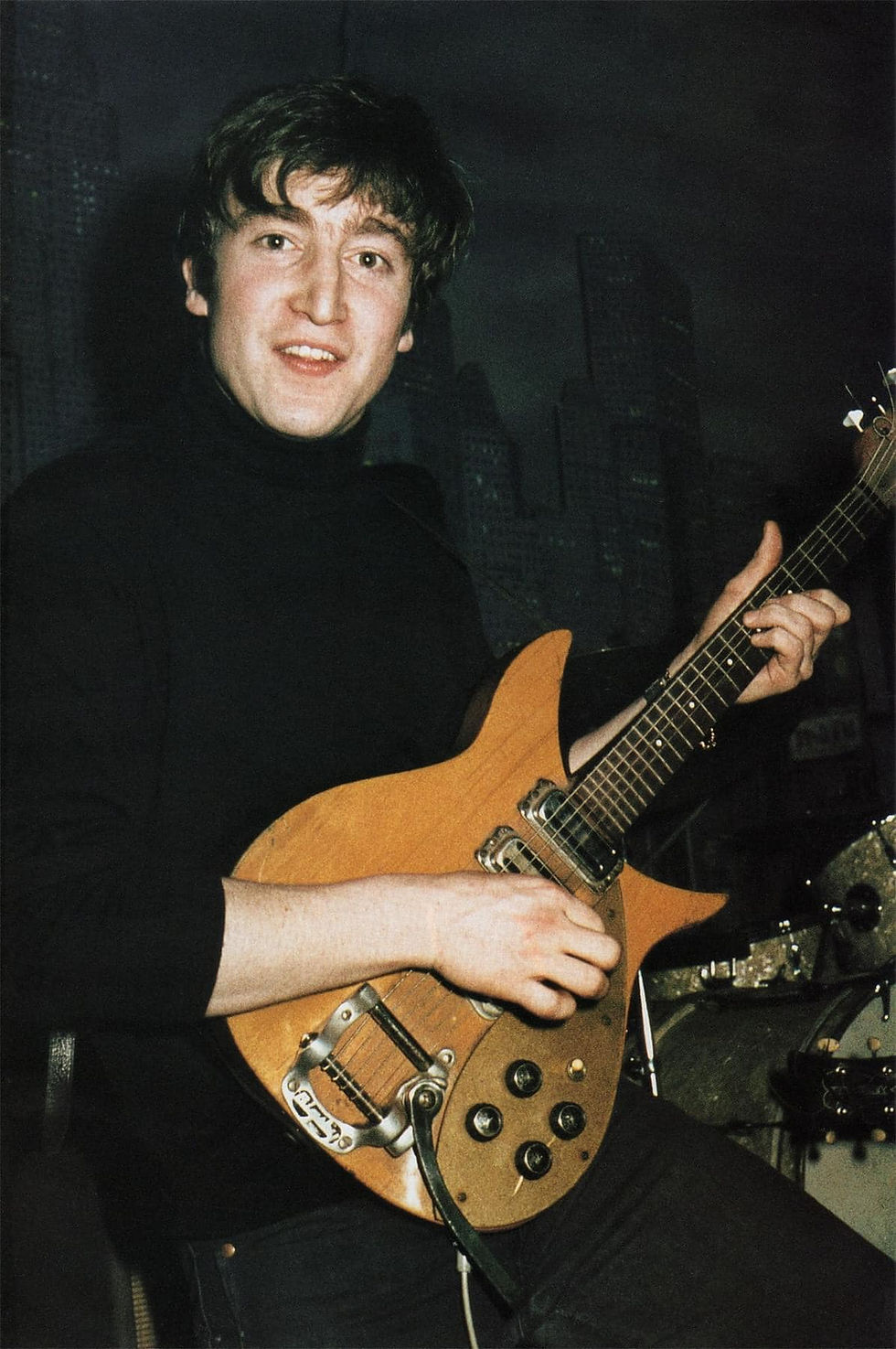
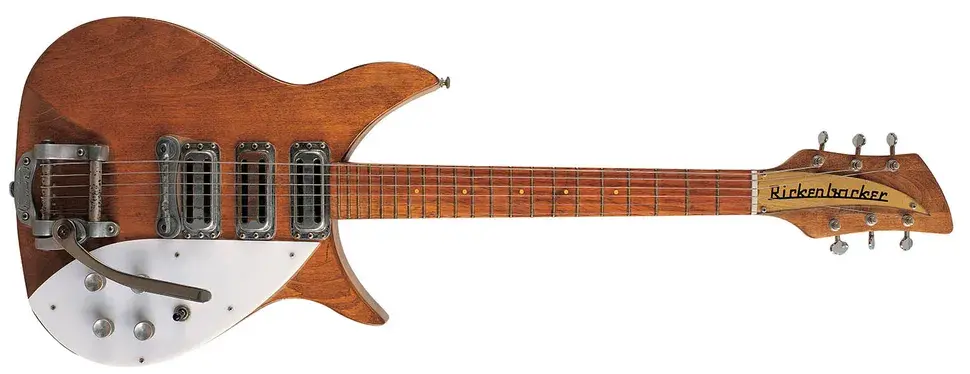
Notwithstanding its famous owner, John's 325 was extremely rare to begin with. Only 28 325 Capri's were manufactured in 1958, only 8 had a natural finish, only 4 had a solid top, and only 3 had 4 knobs. Some believe this guitar was more of a prototype rather than an actual production guitar which makes sense to me.
Regardless of how it ended up there, John purchased the 325 in Hamburg in late 1960 leading this guitar to sometimes be called his "Hamburg" Rick. It went through extensive modifications before Beatlemania and again in the '70s.
By 1961 John had replaced the large Rogan "stove" knobs and had the Kauffman vibrola replaced with a Bigsby vibrato. In September of 1962 he had it re-finished black, some say to match George's black Gretsch Duo Jet.
John played the Capri extensively through the explosion of Beatlemania until 1964 when he mostly retired it after the Carnegie Hall shows on 12 February. John is said to have used the Capri again during the Beatles For Sale sessions later in 1964 before it was retired for good.
By the '70s the Capri was in a shambles, so John commissioned luthier Ron DeMarino to restore the Capri to it's former glory in 1972. DeMarino was a luthier John had met that year and would informally look after many of John's guitars in the '70s. DeMarino refinished the guitar to what he called a "honey gold" finish, completely fixed the badly damaged wiring and electronics, and replaced the damaged pickguard and Grover tuners. According to records, John paid a whopping $1,749.40 for the restoration job, roughly $13,497.37 in 2025 money.
For an extensive history of this guitar, see Glen Lambert's article "Lennon's 1958 Rickenbacker 325: An Evolution that Produced a Revolution" here. To see a detailed recounting of the 1972 restoration, see this article on The Canteen.
Roland SPV-355
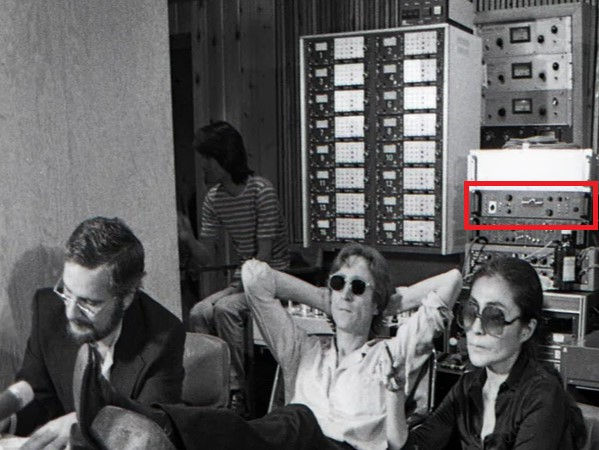
A Roland SPV-355 rackmount synth can be seen in the control room during the Double Fantasy sessions. I don't have any direct evidence on what (or even if) it was used for on the album. Although John wasn't necessarily what I would consider a "gearhead", he did seem to be intrigued by anything he could use to conjure unconventional sounds and the SPV-355 would certainly qualify.
The SPV-355 is an analog synthesizer module first released in 1979, designed primarily as a pitch-to-voltage converter and synthesizer for guitar or other monophonic audio sources. Part of Roland’s rackmount series, it allows players to control synthesizer sounds directly from an instrument by tracking pitch and dynamics, effectively turning a guitar or similar audio input into a synth controller. The technology was new and it had imperfect tracking behavior, but has developed a cult following over the years for it's flexibility in creating analog tones.

Roland SVC-350
Right above the Roland SPV-355, we can see a Roland SVC-350 vocoder in the control room. There are at least two instances of vocoder on Double Fantasy that I'm aware of.
The chorus of "Beautiful Boy (Darling Boy)" features a vocoded John singing "Beautiful, beautiful, beautiful, beautiful boy" behind the lead vocal, and there is a vocoder treated horn part on "Cleanup Time".
"In that song [Cleanup Time] you hear background vocal, "Got to clean up, clean up." I used the horns to trigger a vocoder. I think I sang "Got to clean up, clean up" so it made the horns sound like vocals" explains engineer Lee DeCarlo. "You play a synthesizer, you sing into a microphone, and it picks up the characteristics of the chords and turns it into vocals. The background vocals in there are actually the horn players being turned into voices." (Sharp, 2010, p. 153).
Although John was gifted a Sennheiser VSM-201 vocoder on 9 October, I believe that the SVC-350 was most likely the vocoder used for "Beautiful Boy (Darling Boy)" and "Cleanup Time". The SVC-350 is visible in the control room during the mixing sessions and one would imagine that John took the VSM-201 home.
The Roland SVC-350, released in 1979, is a classic 11-band analog vocoder celebrated for its lush, warm sound and straightforward design, making it a staple in both studio and live setups. Housed in a 2U rackmount unit, it features a built-in microphone preamp, carrier input for external synths, and formant controls that let users shape and articulate the human-voice-like qualities of the vocoded signal. Its simple front panel, with clearly labeled sliders for each frequency band, allows precise sculpting of the carrier signal to mimic speech or create robotic, choir-like textures. The SVC-350’s distinctive character has made it a favorite among artists across electronic, pop, and experimental music, earning a reputation as one of the most musical and expressive vocoders of its era.
Sardonyx 800 D II
John is said to have almost exclusively used the wonderfully bizarre Sardonyx 800 D-2 electric guitar for the Double Fantasy sessions. The Sardonix was the brainchild of Jeff Levin, a luthier who repaired guitars at Matt Umanov Guitars, a shop in the West Village of New York City where he also sold the guitars. Lennon was said to frequent Matt Umanov Guitars so it's likely there that he encountered the Sardonix.

The 800 D featured a small rectangular body, made out of wood, and two stainless steel “outrigger” bars that acted like the "bouts" of a traditional guitar to balance the guitar against the body and to connect a strap. There were six different electronic configurations available for the 800 D, John's is said to be the "D-2" version which featured "dual channel circuitry" with "six different tone combinations per channel" according to official literature. Various switches and knobs could be used to send a variety of pickup blends in various phase configurations through various outputs.
Sardonix advertisements say that D2's came with either "DiMarzio PAF" or "SDHB" (presumably Seymore Duncan Humbucker) pickups. Examination of photos of John's 800 D-2 show that the pickup's pole pieces look to be hex/allen which would be consistent with the pickups that DiMarzio was making in the '70s. Dimarzio, however, tells me that they are not PAFs because they (PAFs) had one screw coil and one slug coil, but that they could be their "Super Distortion" or "Super 2" models. They also told me that they were not the only manufacturer using hex/allen poles for pickups in the '70's and could not rule out them being from another company.
“I bought this beautiful electric guitar, round about the period I got back with Yoko and had the baby,” John said. “It’s not a normal guitar; it doesn’t have a body. It’s just an arm and this tube-like, toboggan-looking thing, and you can lengthen the top for the balance of it if you’re sitting or standing up. I played it a little, then just hung it up behind the bed, but I’d look at it every now and then, because it had never done a professional thing, it had never really been played. I didn’t want to hide it the way one would hide an instrument because it was too painful to look at – like, Artie Shaw went through a big thing and never played his clarinet again. But I used to look at it and think, ‘Will I ever pull it down?’
“Next to it on the wall I’d placed a wooden number nine and a dagger Yoko had given me – a dagger made out of a bread knife from the American Civil War, to cut away the bad vibes, to cut away the past symbolically. It was just like a picture that hangs there but you never really see, and then recently I realized, ‘Oh, goody! I can finally find out what this guitar is all about,’ and I took it down and used it in making Double Fantasy.”- John Lennon Interview with Jonathan Colt. Rolling Stone, RS 337, January 22nd, 1981.
Sardonix 800 Series Literature
Sennheiser Vocoder VSM-201
Hit Factory owner Edward Germano gifted John a Sennheiser VSM-201 vocoder for his 40th birthday on 9 October 1980. There are some conflicting reports, but the consensus seems to be that there were only a handful of these made and that they were wildly expensive ($20k+ in 1980), so this would have been quite the extravagant birthday gift! Whether or not it was used on Double Fantasy or Milk & Honey is unknown. We do know that it was set up at some point and that John was able to use it to demonstrate "Strawberry Fields Forever".

As I mentioned above in the Roland SPV-355 section, I think its more likely that the SPV-355 was the vocoder used on "Beautiful Boy (Darling Boy)" and "Cleanup Time", but it's not impossible that it was the VSM-201. Mixing sessions returned from the Record Plant to the Hit Factory after 30 September and continued until 14 October. John received the VSM-201 on 9 October. According to assistant engineer Jon Smith, "Beautiful Boy" was mixed during these final two week at the Hit Factory as was "Cleanup Time", so its not out of the realm of possibility they could have used the VSM-201 to do the vocoder parts some time between 9 to 14 October.

Sequential Circuits Prophet-5
A Sequential Circuits Prophet-5 can be seen in photos from the control room. Keyboardist George Small specifically mentioned using the Prophet-5 on "Watching the Wheels in Ken Sharp's book Starting Over. "I’m also playing organ and all those Prophet 5 synthesizer parts [on "Watching the Wheels"], the thing that sounds like a French horn" (Sharp, 2010, p. 162). It was presumably played by Small on other tracks and possibly by John as well.
According to Small, the Prophet was also involved in one of John's expressions of Beatles nostalgia that were seemingly common during the sessions. "We were doing a Prophet 5 synthesizer on that record. We were all in the control room and John start talking about “Strawberry Fields.” Arbitrarily, it was just turned on. There was no specific program. Then he started playing the mellotron beginning of the song. It had an identical sound on the Prophet 5. When that happened, everybody’s jaw just dropped, even John. It was uncanny. It sounded like he started playing the record, that's how exact the sound was and no one had set it up that way." (Sharp, 2010, p. 116).

Slingerland Drums (Andy Newmark)
The drum set played by Andy Newmark on Double Fantasy were his early 1970's Slingerland's. Based on his descriptions to me, I believe them to be Slingerland No. 50N's (New "Rock" Outfit) in what looks like "Black Beauty Pearl" finish. The kick drum looks to have non-stock wood hoops, or possibly the stock hoops with the wrap removed.

The sizes of Slingerland 50N's are: 14x20 kick, 8x12 rack tom, 9x13 rack tom, and 16x16 floor tom. Photos show that they seemingly set up both rack toms, or planned to, but ended up using one for tracking. You can see the orphaned SM57 in the below photo that was in all likelihood set up for the second rack tom to match the SM57 on the other rack tom. Listening to the albums suggests to me that it was in fact only one rack tom for the duration of tracking.
Newmark says he used coated Remo Ambassadors on all of the drums, top and bottom. The kick which presumably also had a coated Ambassador, had no resonant head, only a batter. When I asked about muffling, he told me "Yes I taped paper towels or small bits of cloth, any available material, including a wallet or my check book, etc on the snare and toms when dampening was needed. Sometimes no dampening was needed at all. Sometimes a little. Whatever Jack Douglas the producer and Lee the engineer wanted from the drum sound, I did as they asked." -Andy Newmark, email message to Solo Beatles Studios, 15 October 2024)
The Slingerland's were purchased in 1972 when Newmark was the drummer with Sly And The Family Stone. Newmark told me "All of the band’s equipment, including my Gretsch drums, were stolen in 1972 out of the band’s U-Haul rental truck on 8th Avenue in NYC outside our Holiday Inn hotel." (Andy Newmark, email message to Solo Beatles Studios, 15 October 2024). Sly bought the band all new equipment, including the Slingerland's for Newmark
Newmark gave the Slingerlands away in 1994 and their current whereabouts are unknown "...I played [the Slingerlands] on the Double Fantasy / Milk and Honey recordings and on all my other recording sessions throughout the 1970’s and 1980’s until I went with Yamaha in 1982. I actually gave my Slingerland Drums away in NYC when I moved to England in 1994, not realizing that they might have some “special historic value" in the years to come. But maybe they wouldn't. Either way, it’s too late now. I’ll never know. Goodness knows where they’ve ended up." (Andy Newmark, email message to Solo Beatles Studios, 15 October 2024)

Steelpan (unkonwn make/model)
The steelpan (steel drum) on "Beautiful Boy (Darling Boy)" was played by Robert Greenidge as an overdub on 13 August 1980. According to keyboardist George Small the original plan was to hire a steelpan "orchestra" for "Beautiful Boy" with 20+ players. Ultimately it was decided that they would go with only one player, Greenidge.
Unfortunately, I haven't been able to turn up any information on the specific instrument Greenidge played. Happily, Greenidge is still alive, but I haven't been able to get in touch with him.
Steinberger L2 prototype fretless bass (Tony Levin)
Both Jack Douglas and Bun E. Carlos specifically mention Levin playing a fretless bass on the Double Fantasy sessions. I thought it was possible that the fretless in questions was the Music Man Sabre Levin used on Peter Gabriel's "Sledgehammer" but then I found an interview where Ned Steinberger says it was the Steinberger L2 prototype purchased by Levin at National Association of Music Merchants (NAMM) trade show in 1979. Three L2 prototypes were sold at the time, one to Levin, and the other two went to John Entwistle of The Who, and Andy West of Dixie Dregs.
"Tony Levin was absolutely the first sale. He bought a fretless bass that I made from an early mould. It was significantly different than the instruments now. At the time I was using additional steel reinforcements in the neck along with the graphite. So he had a very unusual fretless instrument, which he played quite a bit at the time. He recorded several of the last John Lennon sessions with a Steinberger bass." -Ned Steinberger (source)
"Watching The Wheels" seems like the most obvious fretless sound to me, especially the end. I think there are other instances across both records ("Beautiful Boy"), but Levin's playing and intonation are so good it makes it hard to tell at times without any big obvious fretless slides. Bun E. Carolos says he also played fretless on the unreleased version of "I'm Losing You" that they recorded on 12 August.
Steinway Grand Piano
The Hit Factory's Steinway grand piano can be seen in use in many live room photos from the Double Fantasy sessions. Unfortunately, the dark finish and dark lighting of the studio make it hard to discern any distinguishing features of the piano other than that it's some sort of Steinway grand in standard ebony finish.

An interesting feature of the piano at The Hit Factory is the isolation enclosure that was seemingly used during tracking. These contraptions, usually home-brew in nature, allowed the piano to be recorded in relative isolation while in the live room with amps and drums playing at full bore. They were typically built from plywood and sat on the top of the piano having been shaped to fit the exact dimensions of the shell. The side by the treble strings would generally be open so that microphones could be placed in, and then was covered with heavy packing blankets for more isolation. The inside was typically lined with acoustic foam to stop any nasty reflections and provide more isolation.
These boxes usually colored the sound of the piano somewhat, but this compromise was probably seen as well worth it at a studio like Hit Factory A6 which didn't have an iso booth large enough to fit a piano. For the Double Fantasy sessions, the open side faced the control room window which was away from the rest of the band. Though the isolation was probably not complete, this would have given them enough flexibility to EQ and compress the piano without washing out the entire mix with bleed.
Based on photos it seems that - as you would probably expect - the isolation shell was removed after the live tracking sessions and replaced with the standard lid for overdubbing.
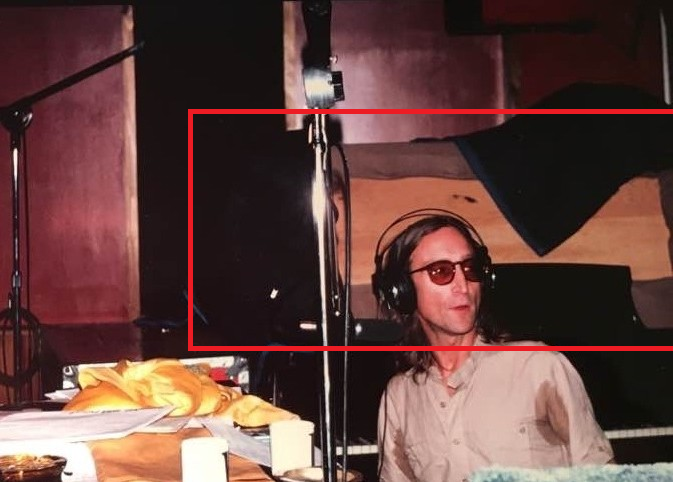
The Hit Factory Studio A6 is still in use today as Sear Sound Studio A. It seems almost certain that when the Hit Factory moved in 1981 that they would have taken all of their gear with them to their new location on West 54th. However, if there is one piece that I think could possibly have remained with the studio it would be the grand piano. Sear Sound's website lists a 1894 Steinway "C" 7.6" Grand Piano as their Studio A piano. Nevertheless, the studio has changed hands more than once since 1981 and its entirely possible, if not likely, that Sear Sound's piano is not the Hit Factory piano from 1980.
Tibetan "Wishing Bell"

John's personal assistant Fred Seaman says in his book The Last Days of John Lennon: A Personal Memoir that the bell used on "(Just Like) Starting Over" was a Tibetan "wishing bell" that John & Yoko owned. It was retrieved by Seaman for the Dakota at John's request and recorded as an overdub at the Record Plant on 27 September during mixing. (Semen, 1991, p.210).
On 9 October 2022, John's official Twitter posted a picture of a silver bell along with a quote from John explaining the reasons for Double Fantasy starting with three bell chimes: "If you listen to the beginning of 'Double Fantasy', you hear 'ping, ping, ping' which is the bell that Yoko calls her Wishing Bell. She rings the bell and makes a wish. I put in on to show the likeness and the difference of the long, long trip from 'Mother' to 'Starting Over'." (@johnlennon Twitter, 09 Oct. 2022, 3:34 p.m., https://x.com/johnlennon/status/1579193485432745986)
After a little internet sleuthing I found that the bell in the social media post is the First Annual Valentine's Day Silver Bell made by Reed & Barton in 1980. I found a Reed & Barton First Annual Valentine's Day Silver Bell on Ebay for $12 and bought it. For what its worth, I'm pretty sure that the bell in the photo is not the wishing bell on "(Just Like) Starting Over" because it does not sound big or deep enough.
Vox AC30 (Earl Slick)
In my interview with Slick, he told me that one of the amps that he brought to the Double Fantasy sessions was his Vox AC30. He said that the Marshall was definitely his main amp but that the AC30 did get used. He didn't provide any specifics as to songs it might have been used on or any details on the era of the AC30.
Of course by 1980 there were several different versions of the Vox AC30 ranging from the various holy grail '60s versions to the somewhat derided 70's Dallas Arbiter-era amps with solid-state rectifiers. Talking to Slick I got the impression that he's not a "gear-head" in the sense that he cares to bother himself about nerdy minutia, but he is a gear-head in the sense he intuitively just selects the good stuff. So it wouldn't surprise me to learn that his AC30 was indeed a classic '60s version.
Washburn A-10-12 (Earl Slick)
One of the precious few seconds of video footage the circulates from the Double Fantasy sessions was the band playing "I'm Losing You" on 19 August 1980. The quality is poor, but in the video Earl Slick looks to be playing a Washburn A-10-12.
Initially, I believed Slick might have only used the A-10-12 for the video sessions, but I now think he possibly played it on the final album version of "I'm Losing You," which was eventually recorded on 26 August. There are some high arpeggiated parts panned to the left that I always assumed were a six-string with modulation, but after seeing Slick had the A-10-12 on the sessions I suspect they could be the 12-string. This is particularly evident in the bridge ("Here in the valley of indecision") section.
The A-10-12 was part of Washburn's Stage Series of guitars that was first released in 1980. It is an an Explorer-style guitar with a set V-shape neck, dual humbuckers, push-pull knobs and a rosewood fretboard. Of course its most unique feature is that six of its 12-strings strings were strung through the neck with their tuners at the bottom of the body.

Wheatstone English Concertina (Randy Stein)
One of the beautiful overdubs on "Beautiful Boy (Darling Boy)" was a concertina played by Randy Stein. According to Stein, the specific Concertina he played on "Beautiful Boy" was a "48 button Wheatstone English Concertina circa 1950. It had wonderful tone even though it was a later model." (Randy Stein, email message to Solo Beatles Studios 25 March 2025)
Stein describes the concertina on his website: "The English Concertina is a fully chromatic instrument, having buttons in a rectangular arrangement of four staggered rows, with the short side of the rectangle addressing the wrist..." He continues "The two innermost rows of the layout constitute a diatonic C major scale, distributed alternately between the two sides of the instrument. Thus, in a given range, C-E-G-B-d is on one side, D-F-A-c-e on the other. The two outer rows consist of the sharps and flats required to complete the chromatic scale. This distribution of scale notes between sides facilitates rapid melodic play."
Stein was brought to the sessions through Jack Douglas's business partner Stan Vincent. Stein wrote a great account of his involvement with the sessions that can be read here.

Yamaha CP-80 Electric Grand Piano
A Yamaha CP-80 Electric Grand Piano can be seen in the live room and heard extensively throughout Double Fantasy. For the tracking sessions it was set up in the live room between the Steinway grand and the Baldwin upright. I've read online that this specific CP-80 was John's - and he did indeed have one at the Dakota - but in the below photo we can clearly see SIR (Studio Instrument Rentals) NY stencil on the side of the piano. According to Keyboardist George Small, John played the distinctive CP-80 parts on "Watching The Wheals" and "Cleanup Time".
The CP series of pianos was Yamaha's attempt to make a portable piano for touring in an era where there were very few options beyond an actual acoustic piano. It uses hammers to strike strings, just like in a traditional acoustic piano and features the same action and frame construction as Yamaha's acoustic pianos. But instead of a wooden soundboard that projects the sound acoustically, the CP-80 has pickups so that the sound can be amplified electronically. Its not at all dissimilar to the differences between an acoustic and electric guitar.
The extremely short string length and magnetic pickups give the CP-80 a tone that is similar to an acoustic piano, but less rich and more "plunky" sounding. Though I'm sure Yamaha was attempting to make the CP series pianos sound indistinguishable from an acoustic piano, they ended up creating a new sound that became popular in its own right. This is evidenced by its use on countless studio albums like Double Fantasy when a beautiful Steinway grand was readily available too.

Yamaha CJ52 Custom "Dragon Guitar"
According to Earl Slick he (Slick) used John's Yamaha Dragon guitar on "Beautiful Boy (Darling Boy)", "John and I played acoustic guitar on ‘Beautiful Boy’ and Hughie played electric. I played John’s black Yamaha acoustic guitar with a dragon on it." (Sharp, 2010, p. 160). Its not clear how much John played the dragon on Double Fantasy, every photo I can find of the sessions show him playing his Ovation Legend, but those could all be from just one day.
John was said to have played Paul Simon's Yamaha L52 some time in the mid 1970s which he apparently enjoyed very much. While visiting Japan in 1977 a meeting was arranged between John and Yamaha executives for him to design a custom guitar. John played a selection of stock Yamaha models and eventually landed on the slightly larger CJ52 which he felt sounded even better than the L52. I believe this would have had to have been a prototype as the CJ52 wasn't actually released until 1980.
John sketched some designs for the guitar which included a large dragon and yin and yang inlays on the body and the Chinese letter for "dragon" on the headstock. John asked for the inlays to be done using the traditional Japanese "Maki-e" technique which involved drawing the characters in lacquer and then sprinkling metal power which would then adhere to the lacquer design. Using the Maki-e technique presented huge problems for Yamaha engineers as it involved being steam-kilned in an environment of 90% humidity.

After an extended period of experimentation, the Yamaha luthiers settled upon an approach that involved completely finishing the guitar with thicker than normal finish first before they added the Maki-e designs. This method slightly dampened the guitar's resonance and low-end projection, but it gave the guitar its own unique character which John was said to have been very pleased with. According to Yamaha it is the most expensive acoustic guitar they have ever produced, even to this day. Pictures suggest that Julian Lennon ended up with this guitar after John's death.

Zildjian A cymbals (Andy Newmark)
Andy Newmark told me in an email that he used the following standard A Zildjian cymbals on Double Fantasy: 20 inch ride, 19 inch crash, 18 inch crash, and 14 inch hi hats. We can see in the below photo that Newmark played his cymbals fairly high compared to many modern drummers which would have greatly aided in minimizing bleed in the close mics on the drums.
My guess is that Newmark would have bought the A's in 1972 when he got the Slingerland drums that he also played on Double Fantasy. He was with Sly And The Family Stone at the time when all of their equipment was stolen from a U-Haul parked outside of the Holiday Inn on 8th Ave in New York City. The Slingerland's were bought to replace the stolen drums and presumably the Zildjian were at the same time too.
The A series of Zildjian cymbals have been produced since 1929 and are about as close to a "standard" cymbal as exists. They've been played by countless legendary drummers on countless recordings. A's are bright and cut through a mix well, a particularly useful characteristic in the tape era.
SOURCES & NOTES
Much of the information contained in the Double Fantasy sections of this site came directly from interviews I conducted:
Assistant Engineer Jon Smith was endlessly helpful, answering countless emails and providing documentation. Smith was very generous with his time.
Drummer Andy Newmark was similarly helpful, answering many questions and follow ups about his drums.
Guitarist Earl Slick spent an hour on Zoom with me. Slick has a seemingly inexhaustible supply of cool stories to tell - a true rock and roll legend.
Randy Stein who played Concertina on "Beautiful Boy" answered questions and kindly sent photos of his Concertina.
Composer Christopher Hedge, owner and caretaker of Matthew Cunningham's Dulcimer, answered questions and provided photos.
Starting Over: The Making of John Lennon and Yoko Ono's Double Fantasy by Ken Sharp - Incredibly interesting and thorough oral history of the Double Fantasy sessions. All the history and stories told by the people that were there. If you want any information about the sessions, outside of the technical, this is the source to get it from.
Eight Arms to Hold You: The Solo Beatles Compendium by Chip Madinger and Mark Easter. An encyclopedia of dates and information regarding solo Beatles recording sessions through the year 2000. Very detailed. A constant reference for me. The book can be purchased as an E-Book here.
The Last Days of John Lennon: A Personal Memoir by Fred Seaman - Seaman was John's personal assistant for a few years until his death. Seaman and this book are not without a lot of controversy, but it was written based on journals he was keeping at the time so there is some very good information about the Double Fantasy sessions, especially where dates are concerned.
Studio Listings. (1980, October). Mix magazine. The "Studio Listings" section of Mix Magazine was incredibly helpful while researching these sections, particularly Vol. 4, No. 9 which was published in October 1980, during the Double Fantasy/Milk and Honey sessions.
Beatles Gear by Andy Babiuk - Far and away the most comprehensive book on the instruments and amplifiers used by The Beatles. Beatles Gear can be purchased here.
https://www.thecanteen.com/lennon1.html - Website with tons of great info on John's Beatle era guitars
https://tilonlysilenceremains.com/the-beatles-guitars-johns-guitars/ - Website with pretty good info on lots of John's guitars from pre-Beatles years to his entire solo career.
This site is for educational and research purposes only.
Fair Use Copyright Disclaimer under section 107 of the Copyright Act of 1976, allowance is made for “fair use” for purposes such as criticism, comment, news reporting, teaching, scholarship, education and research.
Fair use is a use permitted by copyright statute that might otherwise be infringing.
Fair Use Definition
Fair use is a doctrine in United States copyright law that allows limited use of copyrighted material without requiring permission from the rights holders, such as commentary, criticism, news reporting, research, teaching or scholarship. It provides for the legal, non-licensed citation or incorporation of copyrighted material in another author’s work under a four-factor balancing test.


👍
The phot of Lennon playing piano (with underarm sweat stain) which is attributed to "unknown" was taken by Fred Seaman (whose name is frequently misspelled throughout...)